Airbrush Troubleshooting: Every Common Problem & How to Fix It (2026 Guide)
Airbrush not spraying paint, only air? In order of likelihood: dried paint is blocking the nozzle tip, the paint is too thick to flow, the needle is not retracting because the chucking nut is loose, or the air pressure is below about 10 PSI. Check them in that order; Problem #1 walks through each one.
Something’s wrong with your airbrush. You know it because instead of a smooth, fine mist of paint, you’re getting something ugly, spatters, spider webs, bubbles, or nothing at all.
Take a breath. Your airbrush probably isn’t broken. In 15+ years of airbrushing, I’ve learned that 90% of airbrush problems come down to five things: paint consistency, air pressure, a dirty nozzle, a damaged needle, or user technique. The airbrush itself is a beautifully simple device with very few parts. Once you understand how those parts work together, diagnosing problems becomes almost second nature.
This guide covers every common airbrush problem I’ve encountered, or seen other people struggle with on forums, in workshops, and in my own studio. Each section tells you what’s happening, why it’s happening, and exactly how to fix it. I’ve organized them by symptom, because when something goes wrong, you don’t know the cause yet, you just know what it looks like.
Quick Diagnosis: What’s Your Airbrush Doing?
Before diving into details, here’s a fast reference. Find your symptom, then jump to that section.
| What’s Happening | Most Likely Cause | Jump To |
|---|---|---|
| No paint coming out at all | Clog, empty cup, needle too far forward, no air | Problem #1 |
| Paint spitting / sputtering in droplets | Paint too thick, low pressure, tip dry, moisture | Problem #2 |
| Bubbles forming in the paint cup | Air leak at nozzle, cracked nozzle, loose head | Problem #3 |
| Spider web patterns on surface | Paint too thin, pressure too high, too close | Problem #4 |
| Spray pulls to one side | Bent needle tip | Problem #5 |
| Rough / sandpaper texture on surface | Spraying too far away, paint drying mid-air | Problem #6 |
| Orange peel texture | Paint droplets not flowing together, insufficient thinner | Problem #7 |
| Paint sprays without pulling trigger back | Needle not seated, dirty nozzle, flared nozzle tip | Problem #8 |
| Trigger feels stiff or sticky | Dry valve, paint in mechanism, needs lubrication | Problem #9 |
| Paint leaking from back of airbrush | Worn needle seal / packing, pulled needle with paint loaded | Problem #10 |
| Spray pattern pulsates / surges | Moisture in air line, inconsistent compressor, air leaks | Problem #11 |
| Runs and pooling on surface | Too close, paint too thin, too much paint flow | Problem #12 |
| Colors look muddy or contaminated | Incomplete cleaning between colors | Problem #13 |
| Fine lines have fuzzy edges | Pressure too high, paint too thin, needle not sharp | Problem #14 |
Problem #1: No Paint Coming Out at All
What you see: You press the trigger, pull back, and get air, but zero paint. The cup is full and nothing is happening.
Check these in order:
Is your needle too far forward? On dual-action airbrushes, if the needle chucking nut at the rear is loose, the needle may not retract when you pull the trigger back. Open the back handle, check that the chucking nut grips the needle, and that pulling the trigger actually moves the needle rearward. This is the #1 cause I see with new airbrush owners who’ve just reassembled their brush after cleaning.
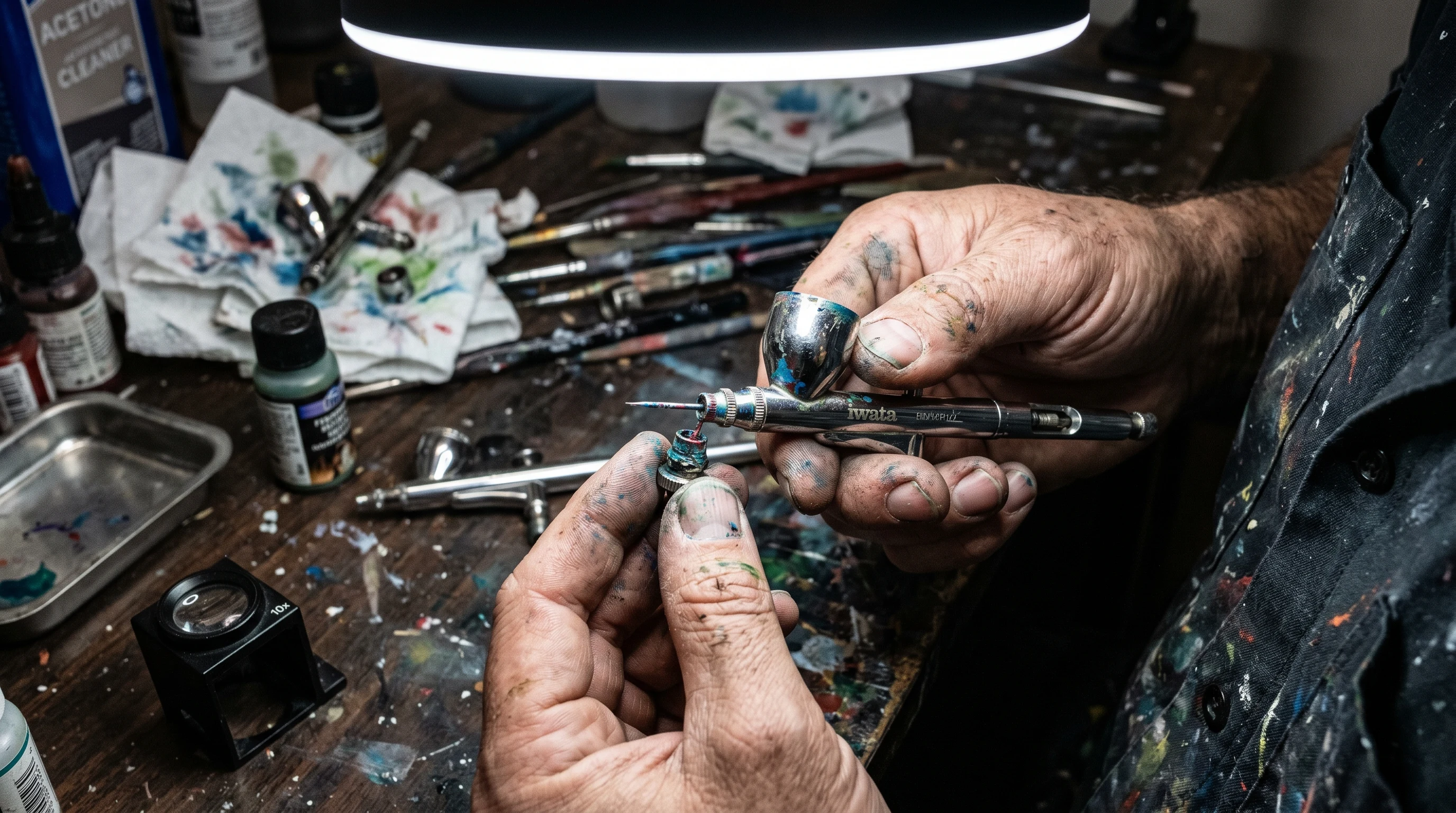
Is the nozzle clogged? Even a tiny speck of dried paint inside the nozzle will block everything. Remove the needle, then unscrew the nozzle (carefully, these are fragile, especially on Iwata and Harder & Steenbeck models). Hold the nozzle up to the light. You should see a clean, round opening. If it’s blocked, soak it in airbrush cleaner for 15–30 minutes and gently clean with a nozzle cleaning brush or interdental brush. Do NOT use metal tools inside the nozzle, you’ll score the interior and create permanent spray problems.
Is the paint too thick? If your paint hasn’t been thinned properly, it literally can’t flow through the narrow channel between the needle and nozzle. Test with water or airbrush cleaner first. If water sprays fine but paint doesn’t, your paint is too thick. Thin it down to skim milk consistency.
Is your air pressure too low? Below about 10 PSI, most airbrushes simply can’t atomize paint. Check your compressor gauge, regulator setting, and make sure there are no kinks in the hose. Start at 20 PSI and work from there.
Is the air valve working? If you don’t feel any air when you press the trigger down (before pulling back), the issue is in the air valve, not the paint system. Check that your compressor is on, the hose is connected, and the air valve inside the airbrush hasn’t seized. A drop of airbrush lubricant on the valve mechanism usually fixes a stuck valve.
Problem #2: Spitting and Sputtering
What you see: Instead of a smooth mist, paint comes out in random droplets, bursts, and specks. Your surface looks like it has measles.
This is probably the most common airbrush complaint, and it has several possible causes:
Paint too thick. This is the cause about 60% of the time. If paint hasn’t been thinned to the right consistency, the air can’t atomize it into a fine mist. Instead, it blasts out in little globs. Fix: thin your paint more. Add reducer (or the appropriate thinner for your brand) gradually until it sprays cleanly. The target consistency is skim milk, paint should flow off a mixing stick smoothly without leaving thick streaks.
Air pressure too low. Low pressure means weak atomization. If your paint is properly thinned and you’re still getting spatter, increase PSI. Try 5 PSI increments until the spray smooths out.
Tip dry. This is when paint dries on the very tip of the needle where it exits the nozzle. A tiny plug of dried paint accumulates, and then a burst of air blows it off, splattering a blob onto your work. This is extremely common with water-based acrylics. Fixes:
- Add a drop of flow improver or retarder (also at SprayGunner) to your paint to slow drying
- Keep a small brush or cotton swab dampened with thinner nearby and wipe the needle tip every few minutes
- If your airbrush has a cutaway crown cap (like the Harder & Steenbeck Infinity, Ultra, or CRplus models), you can wipe the needle tip without disassembly by reaching through the slots
- Between spray passes, give a quick burst of air only (trigger down, not back) to blow residue off the tip
Moisture in air line. Your compressor pulls in room air, which contains moisture. Over time, especially in humid environments, water collects in the line and shoots tiny droplets into your paint stream. Fix: install a moisture trap/water separator between your compressor and airbrush (most compressors with tanks include one, empty it regularly). If yours doesn’t have one, inline moisture traps are inexpensive and screw into any standard fitting.
Damaged needle or nozzle. A bent needle tip or cracked nozzle can cause irregular paint delivery. Inspect both under magnification. Even a barely visible bend will affect spray quality. See Problem #5 for needle repair options.
Problem #3: Bubbles in the Paint Cup
What you see: When you press the trigger, air bubbles up through the paint in the cup instead of (or in addition to) spraying out the front. The paint froths and nothing sprays properly.
This is an air seal problem. Air is going backwards into the cup instead of forward out the nozzle. Check:
Loose nozzle. The nozzle needs to be seated firmly. If it’s even slightly loose, air escapes backward into the paint channel. Gently tighten the nozzle (finger-tight, then a small nudge with the wrench if your airbrush came with one). Do NOT overtighten, you’ll crack the nozzle, which creates an even worse problem.
Cracked or split nozzle. Nozzles are precision parts made from thin, delicate metal (or sometimes ceramic). They crack easily if dropped, overtightened, or if the needle is forced through without proper alignment. A cracked nozzle can’t hold an air seal. Inspect under magnification. If cracked, the only fix is a replacement nozzle (Iwata, Harder & Steenbeck), they can’t be repaired.
Dried paint blocking the nozzle exit. If the front is blocked but air still flows into the body, it has nowhere to go but back up into the cup. Clean the nozzle thoroughly.
Missing or damaged nozzle seal. Some airbrushes (especially Iwata and Badger) use a tiny O-ring or PTFE washer between the nozzle and the body to create an air seal. If this is missing, damaged, or not seated properly, air leaks backward. Check your airbrush’s parts diagram and make sure the seal is present and in good condition.
Problem #4: Spidering (Spider Web Patterns)
What you see: Instead of a smooth coat, paint hits the surface and shoots out in fine tendrils radiating from the center, like spider legs. It looks like a tiny shattered window.
Spidering is essentially the opposite problem of spitting. Where spitting means not enough atomization, spidering means too much force and too little paint body on the surface.
Paint too thin. Over-thinned paint can’t form a coherent film when it lands. Instead of settling into a smooth coat, it splatters outward on impact. Fix: add more paint to thicken your mix, or start with a new batch at a less aggressive ratio.
Pressure too high. The air force is literally blowing the paint sideways when it hits the surface. Reduce PSI in 5 PSI increments until the spidering stops.
Spraying too close. When you hold the airbrush very close (under 1–2 inches) and spray with any real paint volume, the concentrated blast hits with too much force. Move back. For most work, 3–6 inches is the right distance range.
Fix combination: Spidering usually requires fixing all three together, slightly thicken the paint, reduce pressure, and increase distance. Adjust one variable at a time on a test surface until you find the sweet spot.
Problem #5: Off-Center Spray (Pulls to One Side)
What you see: Your spray pattern leans left, right, up, or down instead of spraying straight ahead. Lines curve when they should be straight.
Bent needle tip. This is almost always the cause. Paint exits the airbrush by flowing along the needle and atomizing as it leaves the tip. If the needle tip is bent even slightly, the paint “rolls” off the bend and deflects to one side.
How needles get bent: dropping the airbrush, pushing the needle into a dried plug of paint without soaking first, careless reassembly, or accidentally touching the tip against something while the needle is extended.
Fixes:
- Straighten the needle. Lay the needle on a hard, flat surface (glass or ceramic tile works well). Roll the tip gently with your finger to feel for the bend. Using a fine-grit sharpening stone (1000+ grit), carefully work the bent section back straight by rolling the needle on the stone. This takes patience but can salvage a needle. Magnification helps enormously.
- Replace the needle. If the bend is severe or you can’t get it perfectly straight, a new needle is the reliable fix. Needles for most popular airbrush brands (Iwata, Harder & Steenbeck, Badger) are inexpensive and are the #1 spare part you should keep on hand.
Debris on the air cap. Less commonly, a piece of dried paint on the inside of the air cap (the outer ring at the front of the airbrush) can deflect the air stream. Remove the air cap and clean it thoroughly.
Problem #6: Rough / Sandpaper Texture
What you see: The painted surface feels gritty and looks rough, almost like fine sandpaper, even though it should be smooth.
Spraying too far away. When the airbrush is too far from the surface, paint droplets partially dry during their flight through the air. They land as semi-dry particles instead of wet droplets that flow together. Move closer, usually 3–6 inches for most work, potentially closer for fine detail.
Paint too thick combined with low pressure. Thick paint doesn’t atomize into fine enough particles. The coarse droplets create texture on the surface. Thin the paint more and/or increase pressure.
Dry environment. In very low humidity or air-conditioned environments, water-based paints dry extremely fast, sometimes before they even reach the surface. Adding retarder or flow improver to your paint can help. A few drops per cup load usually makes a noticeable difference.
Problem #7: Orange Peel Texture
What you see: The surface has a dimpled, textured appearance resembling the skin of an orange. It’s clearly paint, but the finish is bumpy rather than smooth.
Orange peel happens when paint droplets land on the surface but don’t flow together into a smooth, uniform film. Each droplet sits individually, creating that textured look.
Not enough thinner / flow improver. The paint is thick enough that individual droplets don’t self-level. Add more thinner and/or flow improver to promote leveling.
Spraying too light or too fast. If you’re doing very quick passes and barely laying down any paint, there isn’t enough wet material on the surface for the droplets to merge. Slow down your hand movement slightly and apply a slightly wetter coat (while being careful not to create runs).
Temperature too cold. Cold paint and cold surfaces don’t self-level well. Try to work in a room that’s at least 65°F / 18°C. If your paint has been stored in a cold garage, let it come to room temperature before spraying.
Solvent-based tip: If you’re using lacquer or Tamiya paints with lacquer thinner, switching to a leveling thinner (like Mr. Color Leveling Thinner) can dramatically reduce orange peel, because leveling thinners contain retarders specifically designed to slow evaporation and promote self-leveling.
Problem #8: Paint Sprays Without Pulling the Trigger Back
What you see: As soon as you press the trigger down for air, paint also starts flowing, even though you haven’t pulled the trigger backward. You get paint when you only wanted air.
Needle not fully seated in the nozzle. If the needle hasn’t been pushed all the way forward, there’s a gap between the needle tip and the nozzle opening, and paint seeps through. Open the back of your airbrush, loosen the chucking nut, push the needle gently forward until you feel slight resistance (that’s the needle seating in the nozzle), then retighten the chucking nut.
Dried paint in the nozzle. A tiny deposit of dried paint inside the nozzle can prevent the needle from seating completely. The solution is a thorough soak and clean of the nozzle.
Flared or damaged nozzle tip. If the nozzle opening has been damaged (from forcing the needle through dried paint, or from the needle being pushed too hard), the opening may be slightly widened or uneven, preventing a proper seal. Replacement nozzle needed.
Important technique reminder: “Air on, air off.” Always press the trigger down (air on) BEFORE pulling back (paint on). When finishing, push the trigger forward (paint off) BEFORE releasing the trigger up (air off). This sequence clears the needle tip with air after each spray pass and prevents the exact problem of paint dribbling when you don’t want it to.
Problem #9: Sticky or Stiff Trigger
What you see: The trigger doesn’t push down or pull back smoothly. It feels gritty, sticky, or requires more force than it should.
Dry air valve. The air valve inside your airbrush has a small spring and often an O-ring or piston that can dry out, especially if the airbrush hasn’t been used for a while. A drop of airbrush-specific lubricant (Iwata Lube, Badger Regdab, or similar) on the air valve mechanism usually fixes this immediately. Do NOT use household oils, many contain additives that can react with paint or degrade rubber seals.
Paint contamination in the trigger mechanism. If paint has migrated backward past the needle seal (usually from pulling the needle out while the cup still had paint in it), it can dry in the trigger area and cause sticking. This is especially common with Iwata airbrushes. Disassemble the trigger mechanism carefully (refer to your model’s parts diagram), clean all components with airbrush cleaner, lubricate, and reassemble.
Overtightened air valve assembly. On some airbrushes (particularly Harder & Steenbeck models), the air valve assembly has an adjustable tension. If it’s tightened too much, the trigger will feel stiff. Loosen slightly until the trigger moves freely but air doesn’t leak when the trigger is released.
Problem #10: Paint Leaking from the Back of the Airbrush
What you see: Paint appears around the back handle, the needle chucking area, or even drips out the rear of the airbrush.
Worn needle packing / seal. Inside your airbrush body, there’s a small seal (sometimes called needle packing, needle bearing, or PTFE gland) that the needle passes through. This seal prevents paint from flowing backward along the needle. Over time, or if exposed to harsh solvents, this seal wears out and begins to leak. Replacement seals are available for most brands and are inexpensive.
Pulled the needle out while paint was loaded. If you remove the needle for cleaning while there’s still paint in the cup, that paint will flow straight through the now-open channel and out the back. Always empty and flush the cup before removing the needle. This seems obvious, but I guarantee most of us have done it at least once.
Problem #11: Pulsating / Surging Spray
What you see: The spray pattern pulses, stronger then weaker, stronger then weaker, in a rhythmic or irregular pattern, even though you’re holding the trigger steady.
Moisture in the air line. Water droplets hitting the paint stream cause intermittent disruption. Install and maintain a moisture trap. Empty it before every session.
Compressor without a tank. Small diaphragm compressors without air tanks deliver air in pulses that match the pump cycle. This is inherent to tankless compressors and can’t be fully eliminated. If this bothers you, upgrade to a compressor with a tank, the tank acts as a reservoir that smooths out the pulses into consistent pressure.
Air leaks at connections. If a hose fitting, quick-disconnect, or the connection at the airbrush is slightly loose, air escapes intermittently, causing pressure fluctuations. Check all connections. Wrap male threaded fittings with Teflon (PTFE) tape for a better seal. Listen for hissing sounds, they indicate leaks.
Partially blocked nozzle. A partial blockage can cause the nozzle to alternately block and clear as paint builds up and then blows through. Clean thoroughly.
Problem #12: Runs and Pooling
What you see: Paint pools in one spot and runs down the surface in drips or rivulets.
This is a technique issue more than an equipment issue:
Too close to the surface. At very close range, even a small amount of paint flow creates heavy application. Move back.
Moving too slowly. If your hand speed doesn’t match your paint flow, you’re depositing too much paint in one spot. Keep your hand moving at a steady, even pace.
Paint too thin. Over-thinned paint can’t hold itself together on a surface and runs easily. Thicken your mix slightly.
Too much trigger pull-back. You’re opening the paint flow too wide. Pull the trigger back less for finer control. Dual-action airbrushes give you this control, use it. For most work, you only need to pull back about 1/4 to 1/3 of the total range.
Fix: Build up color in multiple light passes rather than trying to achieve full coverage in one heavy coat. Three thin coats will always look better than one thick coat.
Problem #13: Muddy or Contaminated Colors
What you see: Your colors look off, muddy, or have a tint from the previous color you were using.
Incomplete cleaning between colors. Paint hides in every crevice of the airbrush, in the cup, the channel between cup and nozzle, inside the nozzle itself, and on the needle. A quick flush isn’t always enough, especially when switching from a dark color to a light one.
Proper color-change cleaning procedure:
- Empty the cup completely.
- Add a small amount of airbrush cleaner or appropriate thinner to the cup.
- Swirl it around the cup walls with a brush or cotton swab.
- Spray the cleaner through the airbrush onto a paper towel until it runs clear.
- Repeat steps 2–4 at least once more.
- For critical color accuracy (white or light yellow after dark colors), remove the needle and wipe it clean with a cloth dampened with cleaner. Paint clings to the needle and will continue to contaminate light colors if left there.
Tip: When switching from dark to light colors, flush extra thoroughly. Going from light to dark is much more forgiving. Planning your painting sequence from light to dark reduces cleaning time significantly.
Problem #14: Fuzzy Lines (Can’t Get Fine Detail)
What you see: You’re trying to spray thin, sharp lines but the edges are soft and fuzzy no matter what you do.
Pressure too high. High pressure creates a wider, more diffuse spray cone. For fine lines, drop to 10–15 PSI (or even lower with very thin paint and a 0.2mm needle).
Paint too thin. Very thin paint “blooms” outward on the surface, feathering the edges of your line. Slightly thicker paint holds a sharper edge. Find the sweet spot between flowing smoothly and staying where you put it.
Too far from the surface. For fine detail, you need to be very close, 1/2 inch to 1 inch from the surface. At this distance, the spray cone is at its narrowest.
Needle size too large. A 0.5mm needle simply can’t produce the same fine line as a 0.2mm needle, no matter what technique you use. If you regularly need hair-thin lines, you need a fine-detail setup (0.15–0.2mm needle/nozzle). The Harder & Steenbeck Ultra 2024 is a great option because it lets you swap between 0.2mm and 0.4mm setups on the same airbrush body.
Worn or damaged needle tip. Even slight wear or rounding of the needle tip reduces line sharpness. Needles are consumable parts, replace them periodically if detail quality matters to your work.
Preventive Maintenance: How to Avoid Most Problems
Almost every problem in this guide can be prevented with a basic maintenance routine. Here’s what I recommend:
After Every Use
- Empty the cup and flush with appropriate cleaner until the spray runs clear
- Spray clean thinner through the airbrush for 10–15 seconds
- Wipe the needle, pull it out carefully and wipe with a soft cloth dampened with cleaner, then reinsert
- Never leave paint sitting in the cup overnight. Ever. Dried paint in the nozzle is the #1 cause of problems
Weekly (If Using Regularly)
- Remove and inspect the nozzle, soak in cleaner if needed
- Check the needle tip under magnification for bends or damage
- Empty your compressor’s moisture trap
- Add a tiny drop of airbrush lubricant to the air valve and trigger mechanism
Monthly
- Full disassembly and deep clean, take apart every component and soak in cleaner
- Inspect all seals and O-rings for wear
- Check the needle seal / packing for leaks
- Clean or replace air filters on your compressor
Essential Cleaning Supplies to Keep on Hand
- Airbrush cleaner. Medea Airbrush Cleaner or Iwata Airbrush Cleaner (water-based paints), lacquer thinner (for solvent paints)
- Cleaning brushes. A set of tiny nozzle brushes / interdental brushes. They’re dirt cheap and essential
- Cleaning pot. Spray cleaner into this instead of into the air. Contains the mess and catches overspray
- Airbrush lubricant. Iwata Super Lube, Badger Regdab, or similar. NOT household oil
- Spare needles and nozzles. Keep at least one spare of each for your primary airbrush. A spare nozzle can save a painting session when your primary cracks
The Universal Troubleshooting Flowchart
When something goes wrong mid-session and you need to get back to work fast, follow this order:
Step 1: Test with clean thinner or water. Empty paint from the cup, add thinner/water, and spray. If it sprays fine, the problem is your paint, not the airbrush. Thin your paint more or mix a fresh batch.
Step 2: Check the needle tip. Pull it out and look at it. Bent? Dirty? Dry paint on the tip? Clean or straighten it. This solves the problem about 30% of the time.
Step 3: Check the nozzle. Remove it, hold it to light, look for blockages or cracks. Soak in cleaner for a few minutes if needed. This solves another 30% of problems.
Step 4: Check your air. Is the compressor on? Is the pressure adequate? Are there any leaks or kinks? Is the moisture trap full?
Step 5: If none of the above works, do a full disassembly and deep clean. Soak all front-end parts (nozzle, air cap, needle cap) in cleaner for 30 minutes. Clean the body’s internal paint channel with a cleaning brush. Reassemble carefully, test with water first.
In my experience, steps 1 through 3 solve about 90% of all mid-session problems.
When to Stop Troubleshooting and Replace Parts
Airbrush parts do wear out. If you’ve cleaned everything, checked everything, and the problem persists, it’s probably time for a replacement part:
Replace the needle if: the tip is visibly bent, the spray consistently pulls to one side even after straightening attempts, or your detail quality has gradually degraded.
Replace the nozzle if: it’s cracked (visible or not, if bubbles persist after thorough cleaning, suspect a hairline crack), if paint sprays without trigger pull-back despite a clean nozzle, or if the opening has been damaged.
Replace the needle seal / packing if: paint consistently leaks backward, or you need to overtighten the packing to stop leaks (which creates excessive friction on the needle).
Replace air valve O-rings if: the trigger sticks even after cleaning and lubrication, or if solvent cleaners have degraded the rubber.
Most replacement parts cost between $5 and $25, and every manufacturer sells them. Having a spare needle and nozzle on hand means you can swap them in immediately and keep painting while you troubleshoot the old parts later.
Frequently Asked Questions
Why does my airbrush spit paint when I first start spraying?
You’re likely not following the “air on first” sequence. Always press the trigger down for air BEFORE pulling back for paint. If you pull back for paint while there’s no airflow, a blob of paint sits at the nozzle tip and gets blasted out with the first burst of air. Air on first, paint on second. Paint off first, air off second.
How do I stop tip dry from ruining my work?
Tip dry is caused by paint drying at the needle tip, especially with water-based acrylics. Add 1–2 drops of flow improver or retarder to your paint. Between passes, give a quick burst of air only to clear the tip. Keep a damp brush or cotton swab nearby to wipe the needle tip periodically. If your airbrush has a cutaway crown cap (Harder & Steenbeck Infinity, Ultra, CRplus), you can wipe the tip without removing the cap.
My airbrush worked fine yesterday but won’t spray today. What changed?
Paint dried somewhere inside the airbrush overnight. Even if you thought you cleaned it, a small amount of paint in the nozzle or paint channel can dry and cause a complete blockage. Remove the nozzle, soak it in airbrush cleaner, and clean the internal channel with a brush. This is why “never leave paint in the airbrush” is rule #1.
Why is water coming out of my airbrush?
Your compressor doesn’t have a moisture trap, or the moisture trap is full and needs emptying. Compressors condense moisture from the air they compress, especially in humid environments. Install an inline moisture trap between the compressor and the airbrush, and empty it before every session.
How often should I replace the needle and nozzle?
With proper care, needles and nozzles can last years. But if you notice a gradual decline in spray quality, fuzzier lines, inconsistent patterns, difficulty getting fine detail, it’s time. Rather than a fixed schedule, replace based on performance. Keeping spares on hand (about $10–20 each) means you can swap and test immediately rather than guessing whether a worn part is causing issues.
Can I use household cleaners (Windex, rubbing alcohol) to clean my airbrush?
In a pinch, yes. Windex works reasonably well for water-based acrylics, and isopropyl alcohol is a decent general cleaner. But dedicated airbrush cleaners are formulated to dissolve paint residue more effectively without damaging seals or O-rings. Avoid using lacquer thinner on airbrushes with rubber seals if you use water-based paints, it can swell or degrade the rubber over time. Match your cleaner to your paint system.
My brand-new airbrush isn’t spraying well out of the box. Is it defective?
Probably not. New airbrushes sometimes have manufacturing residue (oils, metal dust) that needs to be cleaned out before first use. Disassemble the front end, clean all parts with airbrush cleaner, reassemble, and test with water before loading paint. Also double-check that you’ve assembled everything correctly, it’s surprisingly easy to leave out the nozzle seal or misalign the needle on first setup. Consult the parts diagram that came with your airbrush.
Final Word
Every airbrush artist, beginner or professional, deals with these problems at some point. The difference between frustration and a quick fix is understanding what’s happening inside that simple little tool. When you know that bubbles in the cup mean an air seal problem, that spitting usually means thick paint or tip dry, and that spidering means you’re over-thinning or over-pressurizing, you can diagnose and fix issues in under a minute.
Keep your airbrush clean, keep spare needles and nozzles on hand, and remember: when in doubt, test with water first. If water sprays fine, the problem is your paint. If water doesn’t spray fine, the problem is mechanical.
Happy spraying, and if you’ve found a problem that’s not covered here, drop a comment below. After 15+ years, I’m still learning too.
- How to Choose the Right Airbrush Paint in 2026. Complete paint guide by project type
- Best Airbrush for Beginners in 2026. Airbrush buying guide
- Best Compressor for Airbrush. Compressor buying guide