Best Airbrush for Beginners in 2026: The Only Guide You Actually Need
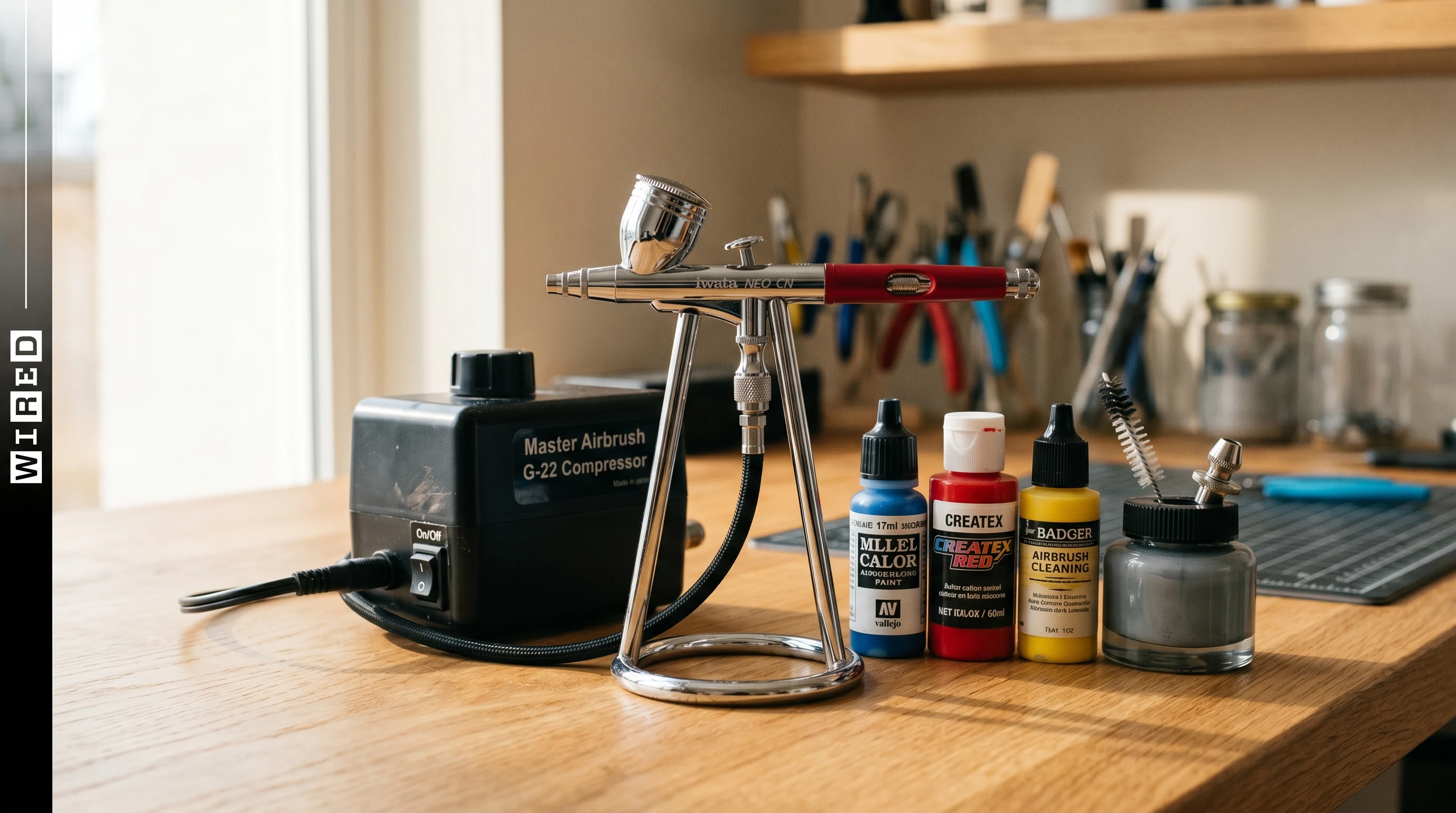
You want to start airbrushing. You’ve watched the YouTube videos, you’ve seen what’s possible, and now you’re ready to buy your first airbrush. But the second you start looking, you’re buried under hundreds of options, conflicting advice, and “best of” lists written by people who have never held an airbrush in their life.
I’ve been airbrushing for over 15 years. I’ve used cheap brushes, expensive brushes, and everything in between. In this guide, I’m going to cut through the noise and show you which airbrushes actually deserve your money in 2026, and more importantly, which ones will help you learn rather than frustrate you into quitting.
Quick answer: If you want one recommendation and don’t want to read the whole article, get the Harder & Steenbeck Ultra 2024. It’s specifically engineered for beginners, it teaches you proper technique from day one, and it grows with you. If you’re on a tighter budget, the Iwata Neo CN (also at SprayGunner) is the best budget value.
But if you want to understand why and find the right match for your specific situation, keep reading.
Already past your first brush? The best airbrush guide goes budget by budget, up to professional gear.
What Makes a Good Beginner Airbrush? (And What Doesn’t Matter Yet)
Before I show you the specific models, let me save you from the biggest mistake beginners make: overthinking specifications.
Here’s what actually matters for your first airbrush:
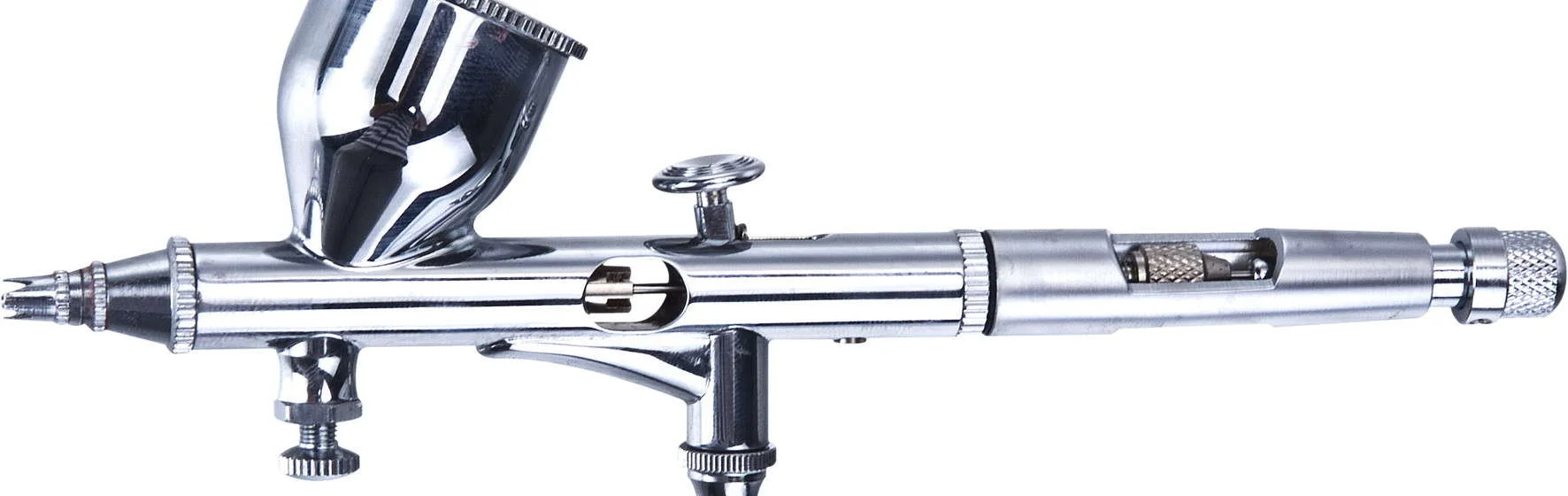
Dual action. This means you control air and paint separately with one trigger. Press down for air, pull back for paint. Yes, it has a learning curve. No, you should not start with single action “because it’s easier.” Single action builds bad habits that you’ll have to unlearn later. Every serious airbrush artist uses dual action. Start there.
Gravity feed. The paint cup sits on top of the airbrush. Gravity pulls the paint down into the nozzle, which means you need less air pressure and waste less paint. This is the standard for 90% of airbrush work today.
Needle size between 0.3mm and 0.5mm. This is the sweet spot for beginners. Anything smaller (0.2mm and under) clogs constantly and punishes every mistake. Anything larger (0.6mm+) is specialized for coverage work. A 0.35mm needle is the most versatile starting point.
Replacement parts available. You will bend a needle. You will need a new nozzle eventually. Buy from a brand where parts are a click away, not a mystery.
And here’s what does NOT matter yet:
- Brand prestige (a top-end Iwata Micron won’t make you paint better than a good entry-level airbrush)
- Needle material (stainless steel is fine)
- Gold plating, PTFE bearings, or other premium features
- Whether your favorite YouTube artist uses it
Now let’s look at the actual airbrushes.
The 5 Best Airbrushes for Beginners in 2026
1. Harder & Steenbeck Ultra 2024: Best Overall for Beginners
Needle: 0.45mm Cup: 5ml gravity feed (removable) + built-in micro-cup Made in: Germany Warranty: 24 months
This is the first airbrush I’ve seen that was genuinely designed for beginners rather than just marketed to them. Harder & Steenbeck took five years of engineering and built three innovations specifically aimed at new users:
Start Control trigger. The trigger is engineered so you physically can’t make the most common beginner mistake (pulling back for paint before pressing down for air). It forces the correct sequence: air first, then paint. This sounds small, but it prevents the sputtering and spitting that makes most beginners think they bought a broken airbrush.
Colour Control system. Five click-stop positions on the needle adjustment that correspond to specific tasks: priming, base coating, glazing, and two levels of highlighting. Instead of guessing “how far do I pull back?”, you dial in a setting and the airbrush limits your paint flow accordingly.
Clog Control. A quick-access headset that lets you see and clean the needle tip without disassembling the whole airbrush. When you’re learning, you’ll be cleaning the tip every few minutes. This saves enormous frustration.
The 0.45mm needle is slightly larger than the typical 0.35mm, which is actually a smart choice for beginners, it’s more forgiving with thicker paints and less prone to clogging, while still capable of fine lines when you’re ready for them.
The real kicker: H&S uses a modular system. When you’re ready for finer detail work, you can buy a 0.2mm or 0.15mm nozzle set, even the famous FineLine system from the premium Infinity, and install it on your Ultra. You don’t need a new airbrush, just a new front end.
Best for: Any beginner who wants to learn proper technique, miniature painters, model builders, general art. Not ideal for: Large coverage work like T-shirts or automotive (the cup is small for that).
2. Iwata Eclipse HP-CS: Best All-Rounder
Needle: 0.35mm Cup: 7ml (0.24 oz) gravity feed with lid Made in: Japan Warranty: 5 years
The Eclipse HP-CS is probably the most recommended airbrush on the internet, and for good reason, it’s been the industry workhorse for over a decade. If the Ultra 2024 is the “smart” beginner choice, the Eclipse is the “safe” one.
What makes the Eclipse special is its high-flow design. The E3 compression-fit nozzle (no threads to cross or break) atomizes paint so well that you barely need to thin most acrylics. For beginners who are still figuring out paint consistency, this is a lifesaver. Where cheaper airbrushes choke on slightly thick paint, the Eclipse just handles it.
The 0.35mm needle hits that perfect middle ground, detailed enough for fine lines and shading, forgiving enough for base coats and larger areas. The 7ml cup with lid means you can mix colors directly in the cup and close it between sessions.
The cutaway handle makes cleaning dead simple: loosen the back, push the needle forward, wipe, done. Spare parts (needles, nozzles, O-rings) are available at every art supply store and dozens of online retailers.
Why it’s not #1: It costs considerably more than the Ultra 2024 for a similar capability level. It also doesn’t have any beginner-specific engineering, you’ll make all the standard beginner mistakes and learn from them the hard way. That said, many professionals still use their Eclipse daily after 10+ years, so it’s absolutely a “buy once” airbrush.
Best for: Artists who plan to airbrush across multiple disciplines (models, illustration, custom painting, textiles). Not ideal for: Tight budgets.
3. Badger Patriot 105: Best Budget Workhorse
Needle: 0.50mm (larger than most beginner recommendations) Cup: Gravity feed Made in: USA Warranty: Lifetime warranty on manufacturing defects
The Patriot 105 is the blue-collar airbrush. No fancy innovations, no marketing buzzwords, just a solid, reliable tool made in the USA that does exactly what it’s supposed to do.
The 0.50mm needle is larger than what most guides recommend for beginners, and that’s actually an advantage in some cases. It’s virtually impossible to clog (thick primers, metallic paints, and heavy acrylics flow through it without complaint), and the wider spray pattern means you cover ground faster. If your main interest is scale models, miniature armies, or terrain painting, the Patriot’s generous flow is a huge productivity boost.
The trade-off is precision. You won’t achieve the same hairline detail as a 0.35mm or smaller needle. For base coats, priming, varnishing, and broad color work, the Patriot is outstanding. For eyes on miniatures or tight fades on illustrations, you’ll eventually want something finer.
Badger’s “Easy Access” needle removal system makes cleaning genuinely fast, and replacement parts are affordable and easy to find (this is an American company, parts ship fast within the US).
Best for: Model builders, miniature army painters (batch priming), terrain work, anyone who prioritizes durability over precision. Not ideal for: Fine detail illustration, portrait work.
4. Iwata NEO CN: Best Budget Pick
Needle: 0.35mm Cup: 7ml (0.24 oz) + 2.8ml (0.10 oz) gravity feed Made in: China (Iwata design and QC) Warranty: 1 year
The NEO CN is Iwata’s answer to the flood of cheap Chinese airbrushes: give beginners an actually functional tool at a budget price, backed by Iwata’s quality control and parts availability.
Is it as refined as the Eclipse? No. The trigger feel is a bit stiffer, the atomization isn’t as silky smooth, and the chrome plating won’t last as long. But here’s the thing, it works. Out of the box, reliably, with standard hobby paints. That alone puts it miles ahead of the $15–25 Amazon mystery airbrushes that might work for two weeks before the trigger starts sticking or the nozzle develops an irreparable leak.
The NEO comes with two cups (large for coverage, small for detail work), which is a nice touch at this price point. It uses Iwata’s N3 nozzle system, and while parts aren’t as universally available as Eclipse parts, you can order them from any Iwata dealer.
Important: The NEO is built to a price. If you airbrush regularly, expect to upgrade within 6–12 months. Think of it as your learner’s permit airbrush, it teaches you the fundamentals and you graduate to something better once you know what you actually need.
Best for: Total beginners testing the waters, students, people who aren’t sure if airbrushing is for them, cake decorating hobbyists. Not ideal for: Anyone who knows they’ll stick with the hobby (spend a little more upfront).
5. Paasche Talon TG-3F: Best Kit Value
Needle: 0.38mm (kit includes 0.25mm, 0.38mm, and 0.66mm heads) Cup: 0.40 oz gravity feed with lid Made in: USA (Chicago. Paasche has been there since 1904) Warranty: Limited warranty
If you want options right out of the box, the Talon kit gives you the most hardware per dollar of any reputable brand. Three spray head sizes let you go from fine detail (0.25mm) to broad coverage (0.66mm) plus a fan air cap for wide patterns, all with one airbrush body.
The 0.38mm default needle is a great all-rounder, slightly larger than the standard 0.35mm, giving you a touch more forgiveness without sacrificing much detail. The build quality is solid (chrome-plated stainless steel with an anodized aluminum handle), and Paasche’s 120+ year heritage means they’re not going anywhere.
The catch: Paasche uses proprietary hose fittings. Your Talon won’t plug directly into a universal quick-disconnect without an adapter. The kit includes 6 feet of Paasche hose, so you’re covered initially, but keep this in mind for the future. Also, the needle must be removed from the back for cleaning, slightly less convenient than the Eclipse’s cutaway design.
Best for: Beginners who want to experiment with different spray sizes without buying multiple airbrushes, T-shirt artists, mixed-media creators. Not ideal for: People who value simplicity (the multiple heads can be overwhelming at first).
Quick Comparison Table
| Airbrush | Price tier | Needle | Cup | Made In | Best For | My Rating |
|---|---|---|---|---|---|---|
| H&S Ultra 2024 | Budget | 0.45mm | 5ml + micro-cup | Germany | Learning technique, miniatures | ★★★★★ |
| Iwata Eclipse HP-CS (also at SprayGunner) | Mid-range | 0.35mm | 7ml | Japan | All-around versatility | ★★★★★ |
| Badger Patriot 105 (in stock at SprayGunner) | Budget | 0.50mm | Gravity | USA | Priming, coverage, durability | ★★★★☆ |
| Iwata NEO CN | Budget | 0.35mm | 7ml + 2.8ml | China (Iwata QC) | Budget/testing the waters | ★★★★☆ |
| Paasche Talon TG-3F | Budget | 0.25/0.38/0.66mm | 0.40 oz | USA | Kit value, versatility | ★★★★☆ |
What About Cheap Amazon Airbrushes? (The $15–30 Kits)
Let me be direct: don’t waste your money.
I know the allure, “I’ll just get a cheap one to see if I like it.” The problem is that a $20 airbrush doesn’t show you whether you like airbrushing. It shows you whether you enjoy fighting with a poorly machined tool that clogs every three minutes, sprays unevenly, and breaks within weeks.
These cheap kits (usually sold under generic names like “Gocheer,” “VIVOHOME,” “Timbertech” with bundled airbrush) have poor needle tolerances, inconsistent nozzle seating, triggers that develop slop quickly, and nozzles that can’t be replaced because the threading is non-standard.
You’ll spend more time cleaning clogs and troubleshooting problems than actually painting. Then you’ll conclude “airbrushing isn’t for me”, when the reality is that your tool was broken from day one.
The Iwata NEO CN is the absolute floor I’d recommend. Below that, you’re gambling.
What Else Do You Need? (Essential Starter Kit)
An airbrush alone is just a fancy pen without ink. Here’s the minimum you need to actually start painting:
Air compressor. Get one with a tank (even a small 3-liter one). Tankless compressors pulse, which causes uneven spray patterns. Budget option: any quiet compressor with regulator and moisture trap in the $80–120 range. I’ll cover compressors in detail in a separate article.
Airbrush hose. Usually 6–10 feet braided hose. Many value sets include one. Make sure the fittings match your compressor and airbrush (most use 1/8” BSP).
Paint. For beginners, I recommend starting with Createx Airbrush Colors (also at SprayGunner) (water-based acrylic, easy cleanup, widely available) or Vallejo Model Air (also at SprayGunner) (pre-thinned, ready to spray for miniature/model work). Don’t buy every color, start with a basic set of primary colors plus black and white.
Cleaning supplies. Airbrush cleaner (Medea or Createx), cleaning brushes (the thin bristle ones that go through the body), and paper towels. Budget ~$15–20.
Spray booth or ventilation. Even with water-based paints, you’re atomizing particles. A portable spray booth with exhaust fan ($40–60) or at minimum a well-ventilated workspace.
Practice paper. Cheap illustration board or cardstock. You’ll use a lot of it learning control exercises.
How I’d Spend My Money (If I Were Starting Over in 2026)
Budget setup (~$150–180 total):
- Iwata NEO CN
- Generic compressor with tank (~$90–100)
- Createx starter paint set
- Cleaning supplies (~$15)
Sweet spot setup (~$250–300 total):
- Harder & Steenbeck Ultra 2024
- Quality compressor with tank and regulator (~$120–140)
- Paint set appropriate to your interest (~$25–35)
- Cleaning kit + practice supplies (~$20)
Buy once, cry once (~$350–450 total):
- Iwata Eclipse HP-CS
- Quality compressor with tank (~$130–150)
- Good paint selection (~$40–50)
- Proper cleaning kit, spray booth, supplies (~$40–60)
Final Thoughts
The airbrush market in 2026 is better than it’s ever been for beginners. The Harder & Steenbeck Ultra 2024 genuinely changed the game by designing an airbrush that teaches you, something no manufacturer had done before. The tried-and-true options like the Iwata Eclipse and Badger Patriot are as reliable as ever. And even the budget segment has a solid option in the Iwata NEO.
The most important thing is to stop researching and start spraying. Pick one of the five airbrushes above, get yourself a compressor and some paint, and spend your first weekend doing control exercises, dots, lines, gradients, daggers. You’ll learn more in that one weekend than in months of reading reviews.
And when you inevitably hit problems (and you will, every beginner does), check out my troubleshooting guides:
- Common Airbrush Problems & Fixes
- How to Clean Your Airbrush Properly
- Best Compressor for Airbrush
Happy spraying. Welcome to the best hobby in the world.,