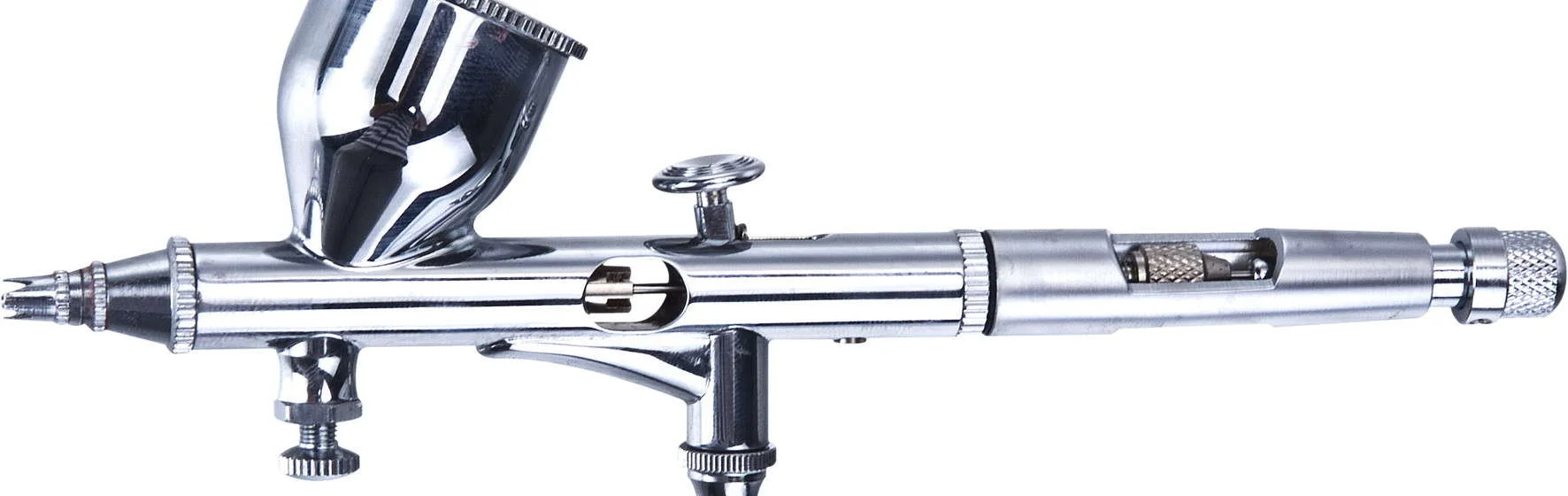
Iwata vs Harder & Steenbeck: Which Airbrush Brand Is Better? (Honest Comparison)
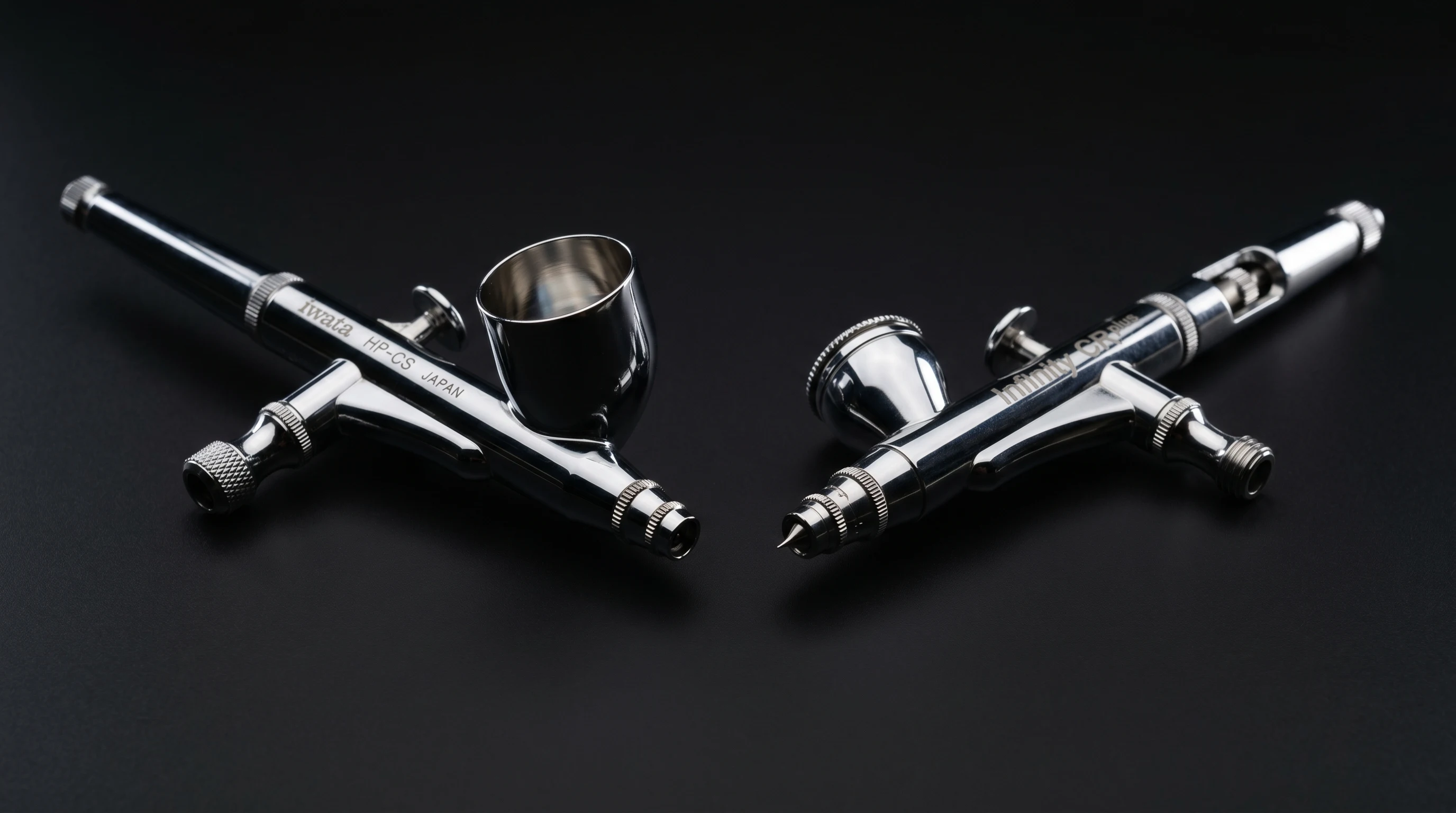
This is the debate that comes up in every airbrush forum, every Facebook group, and every Reddit thread about upgrading: Iwata or Harder & Steenbeck?
I’ve used both brands extensively over 15+ years, and I’ll give you a straight answer, but it’s not the answer you might expect. The truth is that both brands make excellent airbrushes. Neither is objectively “better.” But they have real, meaningful differences in design philosophy that make one or the other a better fit depending on how you work.
Here’s the full breakdown.
The Quick Answer
If you want speed of cleaning and color changes: Harder & Steenbeck. If you want the most refined spray quality and a heavier, more substantial feel: Iwata. If budget for replacement parts matters: Harder & Steenbeck (significantly cheaper spares). If global parts availability and service network matters: Iwata (wider distribution).
Now let’s dig into why.
Company Background
Iwata is a Japanese company founded in 1926. They manufacture airbrushes in Japan with the precision engineering the country is famous for. Iwata airbrushes are sold worldwide and are arguably the most recognized airbrush brand globally. In 2017, Iwata acquired Harder & Steenbeck, so technically, both brands are now under the same corporate parent. However, they continue to operate as separate brands with distinct product lines and design philosophies.
Harder & Steenbeck (H&S) is a German company founded in 1932. Their airbrushes are manufactured in Germany. They’re particularly popular in Europe and have gained massive ground in the miniature painting community over the last decade. Their design approach prioritizes modularity, ease of maintenance, and interchangeable components.
The fact that Iwata owns H&S is worth noting because it means neither brand is going away. They serve different market segments and design preferences by intention, not by accident.
The Biggest Difference: Nozzle System
This single design choice creates the most significant practical difference between the two brands. It affects cleaning speed, maintenance, durability, and daily workflow.
Harder & Steenbeck: Drop-In (Compression-Fit) Nozzle
H&S airbrushes (Evolution, Infinity, Ultra) use a nozzle that simply drops into place, no threads, no wrench, no tools. Remove the air cap by hand, lift out the nozzle, clean it, drop it back in. The nozzle is sealed by the pressure of the air cap screwing down around it.
Advantages:
- Cleaning between colors is dramatically faster, you can clear and inspect the nozzle in seconds
- No risk of cross-threading (a common problem with threaded nozzles)
- No wrench needed, so no risk of over-tightening
- The nozzle itself is larger and easier to handle than threaded nozzles
Disadvantages:
- H&S nozzles are more fragile than Iwata’s. The thin walls of the compression-fit design can crack if dropped or handled roughly
- The seal between nozzle and body relies on the o-ring behind the nozzle. If this tiny o-ring is damaged or missing, you get air leaks and cup bubbling
- Some users report that the nozzle can shift very slightly during use, though this is rare with proper seating
Iwata: Threaded Nozzle
Iwata airbrushes (Eclipse, Hi-Line, Custom Micron) use a nozzle that screws into the body with fine threads. A tiny nozzle wrench (included with the airbrush) is used for installation and removal.
Advantages:
- The threaded connection creates an extremely secure, positive seal
- Iwata nozzles are robust, the threading adds structural strength
- The nozzle doesn’t move once installed, period
- More forgiving of slight damage, a scratched thread still seals
Disadvantages:
- Requires a wrench for every removal. During rapid color changes, this adds time
- Fine threads are easy to cross-thread, especially with cold or paint-gunked fingers. Cross-threading a nozzle damages the body, an expensive mistake
- The nozzle itself is tiny, especially on fine-needle models. Dropping it on a carpet is a recovery mission
- Over-tightening can crack the nozzle or damage the body threads
Which is better?
For painters who change colors frequently (miniature painters, illustrators doing multicolor work): H&S wins. The time saved on every color change adds up significantly over a session.
For painters who set up one color and spray for extended periods (automotive, large surfaces, T-shirts): Iwata’s threaded nozzle is fine, you’re not removing it often, and the secure seal is a plus.
Head-to-Head Comparison
Build Quality and Feel
Iwata airbrushes feel substantial in the hand. They’re typically heavier, with a chrome-finished brass body that gives a sense of precision machining. The trigger action on Iwata airbrushes is smooth but has slightly more resistance, some painters prefer this because it provides more tactile feedback and finer control over paint flow.
H&S airbrushes tend to be lighter, especially the aluminum-bodied models (like the Cult of Paint Infinity). The trigger action is typically lighter and requires less force, which reduces finger fatigue during long sessions but can feel less precise to painters accustomed to Iwata’s heavier action.
Neither is objectively better, this is genuine personal preference. If possible, hold both brands before buying. The feel in your hand matters more than any spec sheet.
Spray Quality
At comparable needle sizes, both brands produce excellent spray patterns. In blind tests (yes, people have actually done these in forum communities), experienced painters generally cannot distinguish between an Iwata and H&S spraying the same paint at the same pressure.
Minor difference: Some painters report that Iwata airbrushes atomize paint slightly more finely at very low pressures (10–15 PSI), producing a softer, smoother spray. This is attributed to tighter internal tolerances and the precise nozzle-to-needle fit that Iwata’s manufacturing achieves. Whether this difference is perceptible to most painters, let alone most viewers of the finished work, is debatable.
Modularity and Upgradability
H&S wins clearly here. The Evolution and Infinity lines share interchangeable needles, nozzles, and cups. Buy an Evolution, and later you can add Infinity-grade components piece by piece. Cups screw on and off, so you can swap between small (2ml) and large (5ml) cups depending on the task. The 2-in-1 concept (shipping with two needle/nozzle sets) is standard across the mid and upper range.
Iwata models are more self-contained. While parts exist for different configurations, swapping between needle sizes usually means buying a different model in the same line. The Eclipse comes with a 0.35mm needle, that’s what it is. Want 0.2mm? You’re buying a different airbrush (HP-C Plus or Custom Micron).
Replacement Parts and Cost
This is where H&S has a significant advantage. H&S replacement nozzles, needles, and seals are considerably cheaper than their Iwata equivalents. H&S nozzles and needles are often cheaper than comparable Iwata parts; check current prices for your model. Over years of use with periodic parts replacement, the cost difference is meaningful.
Iwata counter-argument: Iwata parts are available from more retailers worldwide, and customer service (including warranty claims) is well-established in most markets. H&S availability has improved dramatically in recent years but can still be harder to source in some regions.
Cleaning and Maintenance
H&S is faster to clean in every scenario, quick flush, end-of-session, and deep clean, primarily because of the drop-in nozzle. The screw-on cups also make cup cleaning easier (remove cup, clean at the sink, reattach).
Iwata is straightforward to clean but slower. The threaded nozzle means deep cleaning always requires the wrench. The cups are typically soldered or permanently attached (on most models), so cup cleaning happens in-place.
Seal Systems
H&S upper-range models (Evolution CR Plus, Infinity CR Plus) come with PTFE (Teflon) seals as standard. These are resistant to solvents, which matters if you use lacquer thinners, enamel thinners, or other aggressive chemicals.
Iwata also uses PTFE seals on most models. Budget H&S models (Ultra) and budget Iwata models (Neo) may have rubber seals that degrade faster with solvent exposure.
Model-to-Model Comparison
Here’s how the most popular models stack up against their cross-brand equivalents:
| Category | Harder & Steenbeck | Iwata | Notes |
|---|---|---|---|
| Budget entry | Ultra 2024 (0.2mm) | Neo CN (0.35mm) | H&S has flow limiter; Iwata is cheaper |
| Mid-range workhorse | Evolution 2-in-1 (0.2/0.4mm) | Eclipse HP-CS (0.35mm) | H&S has dual needles; Iwata is proven |
| Premium detail | Infinity CR Plus (0.15/0.4mm) | Hi-Line HP-CH (0.3mm) | H&S has finer needle; Iwata has MAC valve |
| Top-tier precision | Infinity Cult of Paint (0.15/0.4mm) | Custom Micron (0.18mm) | H&S is much cheaper; Iwata is legendary |
At every price point, H&S typically offers more needle/nozzle versatility (2-in-1 sets) for less money. Iwata offers more refined single-purpose tools with tighter manufacturing tolerances.
Spotlight: Iwata Eclipse HP-CS vs H&S Evolution 2024 (2-in-1)
These are the two models most people actually cross-shop, so here’s a focused head-to-head. Harder & Steenbeck completely redesigned the Evolution line in 2024, pulling features down from their flagship Infinity, which makes this matchup closer than it used to be.
| Feature | Iwata Eclipse HP-CS | H&S Evolution 2024 CRplus (2-in-1) |
|---|---|---|
| Default nozzle | 0.35mm | 0.28mm (0.45mm also included) |
| Nozzle design | Drop-in, self-centering (compression fit) | Drop-in, threadless (FineLine head) |
| Cup size | 7ml fixed | 2ml & 5ml interchangeable |
| Trigger | Standard dual-action | Trigger Cam Control system |
| Needle stop | No | Yes (adjustable, repeatable lines) |
| Cleaning | Spanner needed for head cap | Tool-free teardown + Speed Clean trigger |
What’s new in the Evolution 2024
- Trigger Cam Control + needle stop, the trigger runs on an eccentric cam for sharper response, and the adjustable rear needle stop lets you “lock” trigger travel for perfectly repeatable lines. Great for beginners and detail work.
- Tool-free maintenance, full strip-and-rebuild with your fingers, no wrench.
- Speed Clean trigger, ~20% more needle travel when pulled all the way back, so you can flush clogs fast.
- Triple chrome plating + PTFE seals, shrugs off harsh lacquer thinners.
Verdict on this matchup
- Fine detail (mini eyes, panel lines): Evolution 2024, 0.28mm nozzle plus the needle stop.
- Heavy/thick paint (primers, varnishes, unthinned craft paint): Eclipse HP-CS, the 0.35mm setup atomizes high-flow fluids better and resists tip-dry.
- Cleaning speed: Evolution 2024, exposed needle cap, tool-free teardown, Speed Clean trigger.
- Durability: a tie. Iwata’s legendary build vs H&S’s new triple-chrome/PTFE construction. Both last a lifetime if cared for.
If you mostly paint miniatures and want maximum versatility out of one box, the Evolution 2024 2-in-1 is the pick. If you want an indestructible “set it and forget it” workhorse for base-coating and clears, the Eclipse HP-CS (also at SprayGunner) is hard to beat.
Who Should Buy Harder & Steenbeck
- Miniature painters. Frequent color changes make the drop-in nozzle invaluable
- Budget-conscious painters. More versatility per dollar, cheaper replacement parts
- Painters who value modularity. Interchangeable parts across lines, 2-in-1 options
- Beginners. The Ultra 2024’s flow limiter is the best training feature in any airbrush
- People who hate fiddly maintenance. Tool-less disassembly is genuinely pleasant
Who Should Buy Iwata
- Painters who value spray refinement above all. Iwata’s atomization at low pressure is exceptional
- Automotive and illustration painters. The heavier trigger feel and more substantial body suit long, continuous spraying sessions
- Painters who already use Iwata. Muscle memory is real. If you know how an Iwata trigger feels, switching to H&S takes adjustment
- Painters in regions where H&S parts are hard to source. Iwata’s global distribution is broader
- People who prefer a heavier, more substantial tool. If light airbrushes feel “cheap” to you, Iwata’s heft is reassuring
The Fun Fact: Iwata Owns Both
Since 2017, Iwata (technically Anest Iwata Corporation) has owned Harder & Steenbeck. Both brands continue operating independently with different design teams, manufacturing facilities (Japan for Iwata, Germany for H&S), and product philosophies.
This means the “rivalry” is somewhat manufactured, both brands profit the same parent company. But the products themselves remain genuinely different, so the comparison is still valid and useful for buyers.
Frequently Asked Questions
Is Harder & Steenbeck as good as Iwata?
Yes. Both brands produce professional-quality airbrushes. H&S airbrushes are German-engineered with excellent precision and reliability. The brands differ in design philosophy (H&S prioritizes modularity and ease of cleaning, Iwata prioritizes spray refinement and build heft), but neither is superior in overall quality. Your choice should be based on which design approach matches your workflow.
Are Harder & Steenbeck parts compatible with Iwata?
No. Despite being owned by the same parent company, H&S and Iwata airbrushes use completely different needle, nozzle, and component systems. Parts are not interchangeable between brands. Within each brand, there IS cross-compatibility. H&S Evolution and Infinity share parts, and various Iwata lines share certain components.
Why are Iwata parts so expensive?
Iwata parts are manufactured in Japan with extremely tight tolerances, contributing to higher production costs. Iwata also positions itself as a premium brand with pricing to match. H&S offers comparable quality replacement parts at significantly lower prices, which is one reason many painters are switching to H&S for long-term cost reasons.
Can I switch from Iwata to Harder & Steenbeck easily?
The spray technique is identical, you don’t need to relearn airbrushing. The two adjustments are: (1) the trigger feel is different (H&S is typically lighter), which takes a session or two to internalize, and (2) the cleaning/maintenance routine is different (faster with H&S). Most painters adapt within a few uses.
Which brand do professional artists use?
Both. The professional airbrush community is fairly evenly split. Traditional illustration and automotive artists lean slightly toward Iwata (longer history in those fields). The miniature painting and scale model community leans toward H&S (cheaper parts, faster cleaning, 2-in-1 options). In fine art, both brands are well represented.
Final Verdict
If you’re buying your first quality airbrush and have no brand loyalty: Harder & Steenbeck Evolution 2-in-1 is my recommendation. The dual needle/nozzle sets, drop-in nozzle for fast cleaning, and competitive pricing make it the best value proposition for most painters.
If you’ve tried H&S and prefer a heavier trigger with more tactile feedback: Iwata Eclipse HP-CS remains a phenomenal airbrush that has earned its reputation over decades.
Either way, you’re getting a professional tool that will last years with proper care. The gap between these brands is far smaller than the gap between either brand and a cheap no-name airbrush.
- Best Airbrush for Beginners 2026. All brands compared
- Best Airbrush for Miniatures. Model-specific recommendations
- Best Airbrush Kit for Beginners. Kit buying guide
- How to Clean an Airbrush. Cleaning tips for both brands
- Best Airbrush Compressor 2026. Compressor guide
- Airbrush Troubleshooting Guide. Common problems and fixes