Best Airbrush for Miniature Painting in 2026: Warhammer, D&D, Gunpla & Scale Models
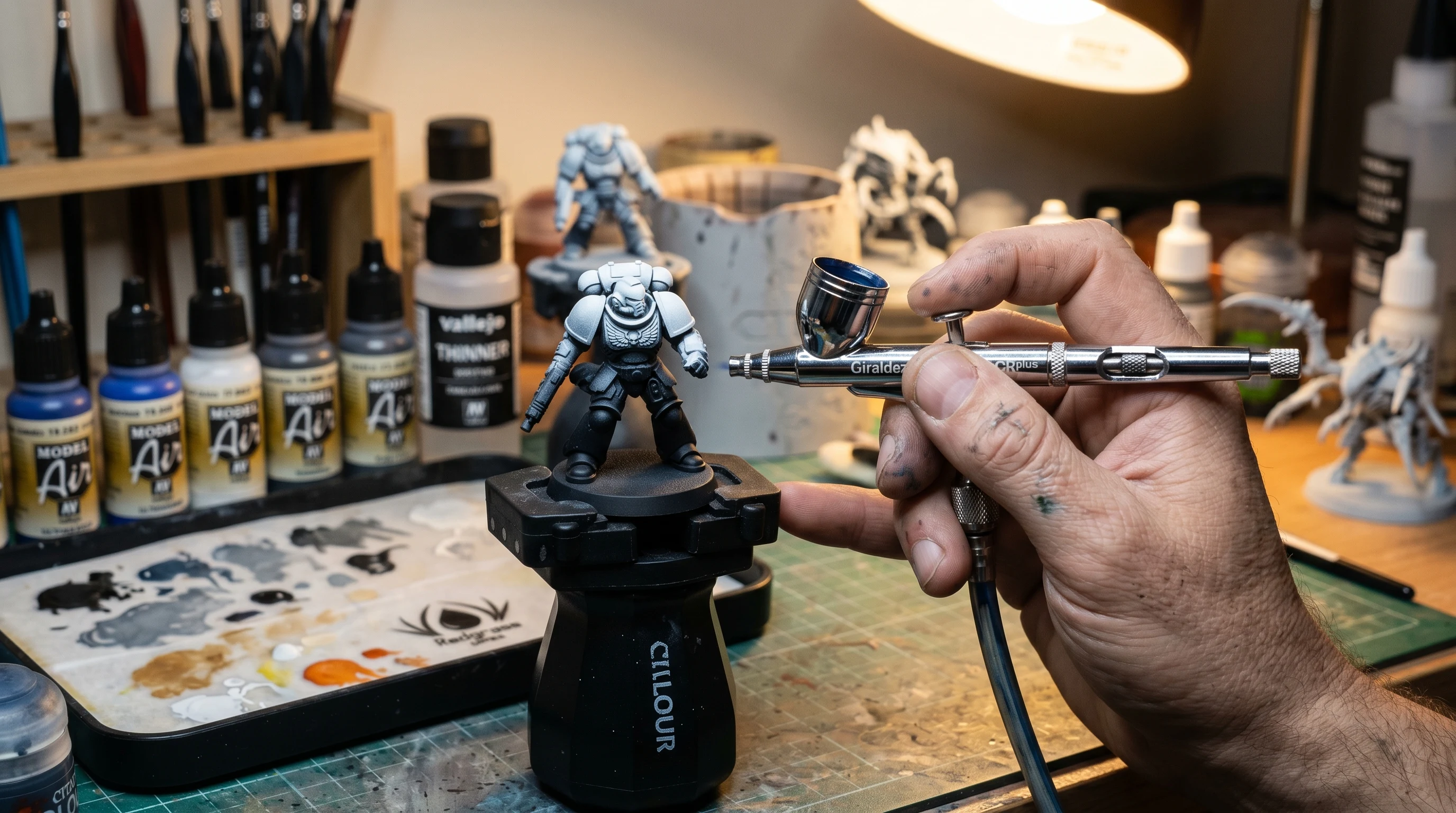
Miniature painting is the fastest-growing segment of the airbrush world right now, and it’s not even close. Between Warhammer 40K, Age of Sigmar, D&D, Gunpla, historical wargaming, and the 3D printing explosion, more people are picking up airbrushes for tiny subjects than ever before.
But here’s the thing, miniature painting has very specific airbrush requirements that are different from other airbrush work. You’re working on objects that fit in the palm of your hand. You need fine control at low pressure. You’re constantly switching colors. And you need to be able to clean quickly, because a clogged airbrush in the middle of a batch of 30 Space Marines is maddening.
I’ve been in the airbrush world for over 15 years. Not all of it focused on miniatures. I come from automotive and fine art airbrush work. But that actually gives me a useful perspective: I can tell you what matters specifically for miniature painting versus what’s just general airbrush marketing fluff.
Here’s what you actually need, and the specific airbrushes I recommend at every budget level.
Quick Recommendation Table
| Airbrush | Needle | Best For | Price | My Take |
|---|---|---|---|---|
| H&S Ultra 2024 | 0.2mm | Beginners, learning | ~$80–110 | Best first airbrush for miniatures |
| Iwata Neo CN | 0.35mm | Budget entry | ~$50–70 | Cheapest quality option |
| Badger Patriot 105 | 0.5mm | Priming, basecoating armies | ~$70–90 | Workhorse, not for detail |
| H&S Evolution 2-in-1 | 0.2/0.4mm | Serious hobbyists | ~$140–180 | Best all-rounder |
| Iwata Eclipse HP-CS | 0.35mm | Versatile mid-range | ~$130–170 | Community favorite for years |
| H&S Infinity CR Plus | 0.15/0.4mm | Advanced painters | ~$200–280 | Maximum detail precision |
| H&S Infinity CRplus Cult of Paint | 0.15/0.4mm | Dedicated mini painters | ~$220–300 | Designed for mini painters, by mini painters |
| Cordless mini compressor kit | 0.3mm | Portability, touch-ups | ~$40–70 | Great for travel, events |
What Makes a Good Airbrush for Miniatures?
Before the specific models, let’s establish what actually matters for miniature painting, because it’s different from automotive, illustration, or cake decorating.
Needle Size: Smaller Than You Think
For miniatures, you want a 0.2mm to 0.35mm needle. This is smaller than what’s recommended for most other airbrush applications.
Why? Miniatures are tiny. A 28mm Warhammer model is about an inch tall. You need to spray fine, controlled lines and dots at very close range (2–4 inches). A 0.5mm needle produces a spray pattern that covers half the model in one pass, useful for priming, but far too broad for detail work like zenithals, fades, and color transitions.
The sweet spot for most miniature painters is 0.2mm for detail and 0.4mm for basecoats/priming. This is exactly why 2-in-1 airbrushes (which come with two needle/nozzle sets) have become so popular in the miniatures community.
Gravity Feed: Non-Negotiable
Every airbrush recommended for miniatures uses a gravity-feed cup on top. Siphon-feed (bottle underneath) airbrushes require higher air pressure to draw paint up, which is the opposite of what you want for delicate miniature work. Gravity feed lets you work at 15–25 PSI with perfect paint delivery, uses less paint (important when you’re working with expensive hobby paints), and makes color changes faster.
Dual Action: Essential for Control
A dual-action trigger gives you separate control over air (push down) and paint (pull back). This is critical for miniatures because you’re constantly adjusting paint flow, a tiny amount for detail, more for basecoats. Single-action airbrushes lock you into one paint flow rate, which is too limiting for the varied work miniature painting demands.
Easy Cleaning: More Important Than You’d Think
Miniature painters switch colors constantly. In a single painting session, you might use 6–10 different colors. Every color change means cleaning the airbrush. If cleaning is tedious (tiny threaded nozzles, difficult disassembly), it slows your entire workflow and makes you dread using the airbrush.
This is where Harder & Steenbeck airbrushes have a massive practical advantage: their drop-in (compression-fit) nozzle system means no wrench, no threading, no fumbling with microscopic parts. You lift out the nozzle, clean it, drop it back. It takes seconds. Iwata and Badger use threaded nozzles that require a tiny wrench, workable, but noticeably slower for frequent color changes.
Low PSI Performance
Miniature airbrushes need to perform well at 15–25 PSI. Many general-purpose airbrushes are optimized for 30–50 PSI (fine for automotive, illustration) but sputter or deliver inconsistent paint at the lower pressures miniature work demands. The airbrushes on this list all perform well at low pressure.
Budget Tier: Under $100
Harder & Steenbeck Ultra 2024: BEST FIRST MINIATURE AIRBRUSH
Needle: 0.2mm | Price: ~$80–110 | Feed: Gravity
The Ultra 2024 is, in my opinion, the best first airbrush for anyone getting into miniature painting. It was designed specifically with miniature painters in mind, and it shows.
What makes it special for miniatures:
The Ultra 2024 has a five-stage paint flow limiter, a dial that restricts how far back you can pull the trigger. This makes a real difference for beginners. Set it to stage 2, and you physically cannot over-spray. It builds confidence and muscle memory in a way that unrestricted airbrushes don’t. As your control improves, you open up more stages until you’re running full dual-action.
It uses the same drop-in nozzle system as the more expensive H&S airbrushes, so cleaning between colors takes seconds. The 0.2mm needle handles detail work beautifully, and it’s perfectly adequate for basecoating individual miniatures (though for batch-priming 30+ models at once, you’d want something with a larger needle).
Who it’s for: Beginners to intermediate miniature painters. Anyone who wants to learn airbrushing with a safety net that prevents the most common beginner mistakes.
Limitations: The 0.2mm-only needle means you can’t swap to a larger size for broad coverage (the Evolution and Infinity lines offer 2-in-1 needle sets). The cup is small (2ml), so you’ll refill frequently during large priming sessions.
Iwata Neo CN: BUDGET WORKHORSE
Needle: 0.35mm | Price: ~$50–70 | Feed: Gravity
If budget is the primary concern, the Neo CN is the cheapest airbrush I’d actually recommend for miniatures. It’s a real Iwata. Japanese-made with good build quality and smooth trigger action. The 0.35mm needle is slightly larger than ideal for fine detail but handles basecoating, priming, and broader color work very well.
The catch: The Neo uses a tiny threaded nozzle that’s fiddly to remove and easy to lose. Cleaning is slower than H&S airbrushes, and if you cross-thread the nozzle during reassembly, you’re in trouble. This is the trade-off for the lower price.
Who it’s for: Painters on a strict budget who want brand-name quality. Good starter if you’re not sure you’ll stick with airbrushing long-term.
Badger Patriot 105: THE PRIMING MACHINE
Needle: 0.5mm (smaller sizes available) | Price: ~$70–90 | Feed: Gravity
The Patriot 105 is a legendary workhorse. It’s tough, reliable, sprays thicker paints without complaint, and is incredibly easy to clean and maintain. Its 0.5mm needle makes it a priming and basecoating champion, you can blast through a tray of models quickly.
For miniatures specifically: The stock 0.5mm needle is too large for detail work. Period. You can buy a 0.3mm needle/nozzle set for the Patriot, which makes it more versatile, but out of the box it’s a broad-coverage tool. Many miniature painters own a Patriot alongside a finer airbrush, the Patriot for priming and basecoating, something like an Evolution or Eclipse for detail.
Who it’s for: Speed painters, army painters, anyone who values durability and simplicity over precision. Excellent if you paint for tabletop standard rather than display competition.
Mid-Range: $100–200
Harder & Steenbeck Evolution 2-in-1: BEST ALL-ROUNDER
Needles: 0.2mm + 0.4mm | Price: ~$140–180 | Feed: Gravity
If I had to pick one airbrush for a miniature painter who wanted one tool to do everything, this is it.
The Evolution 2-in-1 ships with two complete needle/nozzle sets: 0.2mm for detail and 0.4mm for coverage. Swapping between them takes under a minute thanks to the drop-in nozzle system. The build quality is excellent, tight tolerances, smooth trigger, and standard PTFE seals that handle both water-based and solvent paints.
It shares parts with the Infinity line, so when you eventually want to upgrade individual components (like the Infinity’s Quick-Fix preset lever), you can buy them separately without replacing the whole airbrush.
For miniature painting: This covers the full range, zenithal priming with the 0.4mm, then swap to 0.2mm for color modulation, fades, and spot highlighting. The removable paint cups (2ml and 5ml included) make color changes fast.
Who it’s for: Serious hobbyists who want one versatile airbrush that grows with their skills. The best value proposition in the miniature airbrush market.
Iwata Eclipse HP-CS: THE COMMUNITY STANDARD
Needle: 0.35mm | Price: ~$130–170 | Feed: Gravity
The Eclipse HP-CS has been the single most popular airbrush in the miniature painting community for years. Scroll through any Warhammer or miniature painting forum, and “get an Eclipse” is the advice that comes up most often.
And for good reason: it’s beautifully made, incredibly reliable, sprays consistently at any pressure, and has a forgiving 0.35mm needle that handles both broad basecoats and reasonably fine detail. Parts are universally available, and every airbrush shop knows how to service one.
Compared to the Evolution: The Eclipse does one thing well (0.35mm all-purpose) versus the Evolution’s two-size versatility. The Eclipse has a larger cup (7ml vs 5ml), which is nice for priming sessions. But the threaded nozzle makes cleaning slower, and you can’t swap to a finer needle without buying a completely different Eclipse model.
Who it’s for: Painters who want proven reliability and don’t want to think about needle swaps. Excellent for intermediate painters who plan to complement it later with a finer detail brush.
Pro Tier: $200+
Harder & Steenbeck Infinity CR Plus 2-in-1: MAXIMUM PRECISION
Needles: 0.15mm + 0.4mm | Price: ~$200–280 | Feed: Gravity
The Infinity CR Plus is the precision flagship. The “CR” stands for Chrome, the needle and nozzle are hard-chrome plated for extended lifespan and smoother paint flow. The “Plus” adds the Quick-Fix preset feature, which lets you set a maximum needle retraction point with a dial, then remove and return to that exact setting.
The 0.15mm needle is extraordinary for miniature detail. It produces lines so fine they can simulate individual hair strands on a 28mm model. But it is demanding, it requires perfectly thinned paint, immaculate cleaning, and a steady hand. This is not an airbrush for a beginner.
Who it’s for: Competition painters, display painters, and experienced miniature artists who want the finest possible control. If you’re painting single models for Golden Demon or Crystal Brush competitions, this is the tool.
H&S Infinity CRplus Cult of Paint Edition: DESIGNED FOR MINIATURE PAINTERS
Needles: 0.15mm + 0.4mm | Price: ~$220–300 | Feed: Gravity
This is a collaboration between Harder & Steenbeck and Cult of Paint (renowned miniature painting duo Ben Komets and Roman Lappat). It’s built on the Infinity CR Plus platform but with miniature-specific refinements.
What’s different from the standard Infinity:
The trigger is slightly taller with a curved profile, giving you a wider range of motion and more precise finger control. The body is aluminum rather than brass, making it noticeably lighter, important when you’re holding it at close range for extended detail sessions. It also ships with optimized nozzle geometry tuned for the low-pressure, high-detail work that miniature painting demands.
The Cult of Paint edition launched via Kickstarter and has become the aspirational airbrush in the Warhammer community. Is it necessary? No, the standard Infinity CR Plus is functionally identical in capability. But the ergonomic refinements are noticeable during long painting sessions.
Who it’s for: Dedicated miniature painters who want the absolute best tool available for the specific demands of mini painting. It’s a luxury, but a well-engineered one.
Portable/Cordless Option
Cordless Mini Compressor Kits: FOR EVENTS AND TRAVEL
Needle: Typically 0.3mm | Price: ~$40–70 | Feed: Gravity
The cordless airbrush category has exploded since 2023. These compact, battery-powered units combine a small compressor and airbrush in one handheld or ultra-portable package. They typically deliver 15–25 PSI, run for 30–60 minutes per charge, and are virtually silent.
For miniatures: They’re surprisingly capable for priming, basecoating, and varnishing individual models. They’re perfect for painting at gaming stores, clubs, or conventions where setting up a traditional compressor isn’t practical. They’re also great as a secondary tool for quick touch-ups without firing up your main setup.
Limitations: Limited battery life, lower pressure ceiling, and the bundled airbrushes are basic quality. Not a replacement for a proper setup, but an excellent complement.
Recommended units: Look for models with rechargeable lithium batteries, adjustable PSI (not just on/off), and a 0.3mm gravity-feed airbrush. Brands change rapidly in this category, check current reviews before buying.
Essential Accessories for Miniature Airbrushing
You’ll need more than just the airbrush:
Compressor: A quiet compressor with a tank is ideal. The NO-NAME Tooty or Sparmax TC-501N are popular in the miniatures community. See my full compressor guide for detailed recommendations.
Paints: Not all airbrush paints work well for miniatures. Vallejo Model Air, Citadel Air, and AK Interactive 3rd Gen are pre-thinned and ready to spray. Standard hobby paints (Vallejo Model Color, Citadel Base) need thinning, typically 1:1 with airbrush thinner or flow improver.
Cleaning supplies: Airbrush cleaner, cleaning pot, interdental brushes, paper towels. You’ll use these constantly.
Primer: Badger Stynylrez, Vallejo Surface Primer, or AK Interactive primer. Airbrush-applied primer gives much thinner, more even coats than spray cans, critical for preserving detail on small miniatures.
PSI for miniatures:
- 10–15 PSI: Fine detail work, thin paints, close range
- 15–20 PSI: General color work, most miniature painting
- 20–30 PSI: Priming, basecoating, thicker paints
- 30+ PSI: Rarely needed for miniatures
Moisture trap: Essential regardless of compressor. Even compressors with built-in traps benefit from an additional inline moisture trap close to the airbrush.
Miniature Airbrush Techniques Worth Learning
Once you have your setup, these are the airbrush techniques that make the biggest difference for miniatures:
Zenithal Priming
The single most impactful technique for miniature painters. Prime black, then spray white from above at a 45° angle (simulating overhead light). This creates an instant value sketch that shows you where highlights and shadows fall. Many painters then apply thin, transparent paints over the zenithal, letting the underlying values show through for instant shading.
A 0.35–0.4mm needle at 20–25 PSI works best for zenithal priming.
Color Modulation
Spraying darker shades of a base color into recesses and lighter shades onto raised areas before applying the final color. This creates pre-built depth that shows through the final paint layers. Works beautifully on vehicles, large armor panels, and monster models.
Glazing / Transparent Layering
Applying very thin, transparent layers of paint (heavily thinned, 3:1 or 4:1 thinner to paint) to shift colors gradually. This is how you create the smooth, blended color transitions that define high-level miniature painting.
A 0.15–0.2mm needle at 10–15 PSI gives the finest control for glazing.
OSL (Object Source Lighting)
Simulating light emanating from a source on the model, glowing plasma guns, magical effects, lava, etc. This is done by spraying a bright color (usually a yellow, orange, or blue-white) in a radial pattern from the light source point, then refining with brush work.
Frequently Asked Questions
What is the best airbrush for Warhammer miniatures?
For most Warhammer painters, the Harder & Steenbeck Evolution 2-in-1 is the best overall choice, it covers everything from priming armies with the 0.4mm needle to detail work and color transitions with the 0.2mm. For beginners specifically, the H&S Ultra 2024 with its built-in flow limiter is the safest starting point. For painters focused on competition-level display models, the H&S Infinity CR Plus offers the finest detail possible.
Do I need a 0.2mm needle for miniatures?
Not necessarily. A 0.35mm needle (like the Iwata Eclipse) handles most miniature painting tasks well, basecoating, zenithal priming, broad color work, and even reasonable detail at close range. A 0.2mm needle gives finer lines and more control for advanced techniques like OSL, precise glazing, and ultra-thin freehand. If you’re starting out, 0.3–0.35mm is plenty. You can always add a finer needle later.
Can I use a cheap airbrush for miniature painting?
Yes, but with caveats. Budget airbrushes ($20–40 generic models) will spray paint on miniatures, and they’re fine for learning the basics of trigger control and paint thinning. However, they typically have inconsistent spray patterns, poor trigger feel, and parts that wear quickly. If you’re committed to the hobby, investing in a proper airbrush ($80+) from the start saves money in the long run because you won’t need to replace it as your skills grow.
What PSI should I use for miniature painting?
Most miniature painting happens between 15–25 PSI. Lower pressure (10–15) for fine detail and glazing with thin paints. Medium pressure (15–25) for basecoating and general color work. Higher pressure (25–30) for priming with thicker primers. Start at 20 PSI and adjust from there. If paint splatters, lower the pressure or thin the paint more. If it’s not covering, increase slightly.
Is a spray booth necessary for miniature airbrushing?
Not strictly necessary for small-scale water-based acrylic work (the overspray is minimal), but a portable spray booth ($30–60) captures stray paint mist and prevents it from settling on your desk, models, and lungs. At minimum, use a respirator mask when airbrushing, even with water-based paints, the aerosolized particles are harmful to inhale regardless of the paint type.
Harder & Steenbeck vs Iwata for miniatures, which is better?
Both make excellent airbrushes. The main practical difference for miniature painters is the nozzle system: H&S uses a drop-in nozzle that makes cleaning and color changes significantly faster, while Iwata uses a threaded nozzle that requires a wrench. H&S also offers more 2-in-1 needle options at the mid-range price point. Iwata’s build quality and spray consistency are slightly more refined at comparable price points. If you prioritize speed of cleaning and color changes (critical for miniatures), H&S has the edge. If you prioritize spray refinement and established community support, Iwata is hard to beat.
Can I airbrush Citadel/Games Workshop paints?
Yes, but they require thinning. Citadel Base and Layer paints are too thick for airbrush use straight from the pot. Thin approximately 1:1 with Citadel Airbrush Medium, Vallejo Airbrush Thinner, or even distilled water. Citadel Air paints are pre-thinned for airbrush use, but many painters find they still benefit from a few drops of thinner or flow improver. Citadel Contrast paints work through an airbrush for interesting effects (subtle pre-shading) but behave differently than when brush-applied.
My Recommendation Pathway
If you’re just starting: H&S Ultra 2024 ($80–110). The flow limiter alone justifies it, it prevents the most frustrating beginner mistakes. You’ll get clean results from day one.
When you’re ready to upgrade (or if you want to skip the beginner stage): H&S Evolution 2-in-1 ($140–180). Two needle sizes cover every task. This is the airbrush most miniature painters keep for years.
If you want the best and budget isn’t the concern: H&S Infinity CR Plus or Cult of Paint Edition ($200–300). The finest detail possible, premium build, and a tool that will last your entire painting career.
If budget is tight: Iwata Neo CN ($50–70). A real quality airbrush at the lowest price point worth recommending.
For priming and basecoating armies at speed: Badger Patriot 105 ($70–90). Keep this alongside your detail brush. It’s a beast.
- Best Airbrush for Beginners 2026. Broader guide covering all airbrush uses
- Best Airbrush Compressor 2026. Compressor recommendations
- How to Choose the Right Airbrush Paint. Paint guide by project type
- How to Prepare Any Surface for Airbrush Painting. Priming miniatures
- How to Clean an Airbrush. Essential maintenance
- Airbrush Troubleshooting Guide. When things go wrong