Best Airbrush for T-Shirts 2026: Airbrushes, Paints & Setup Guide
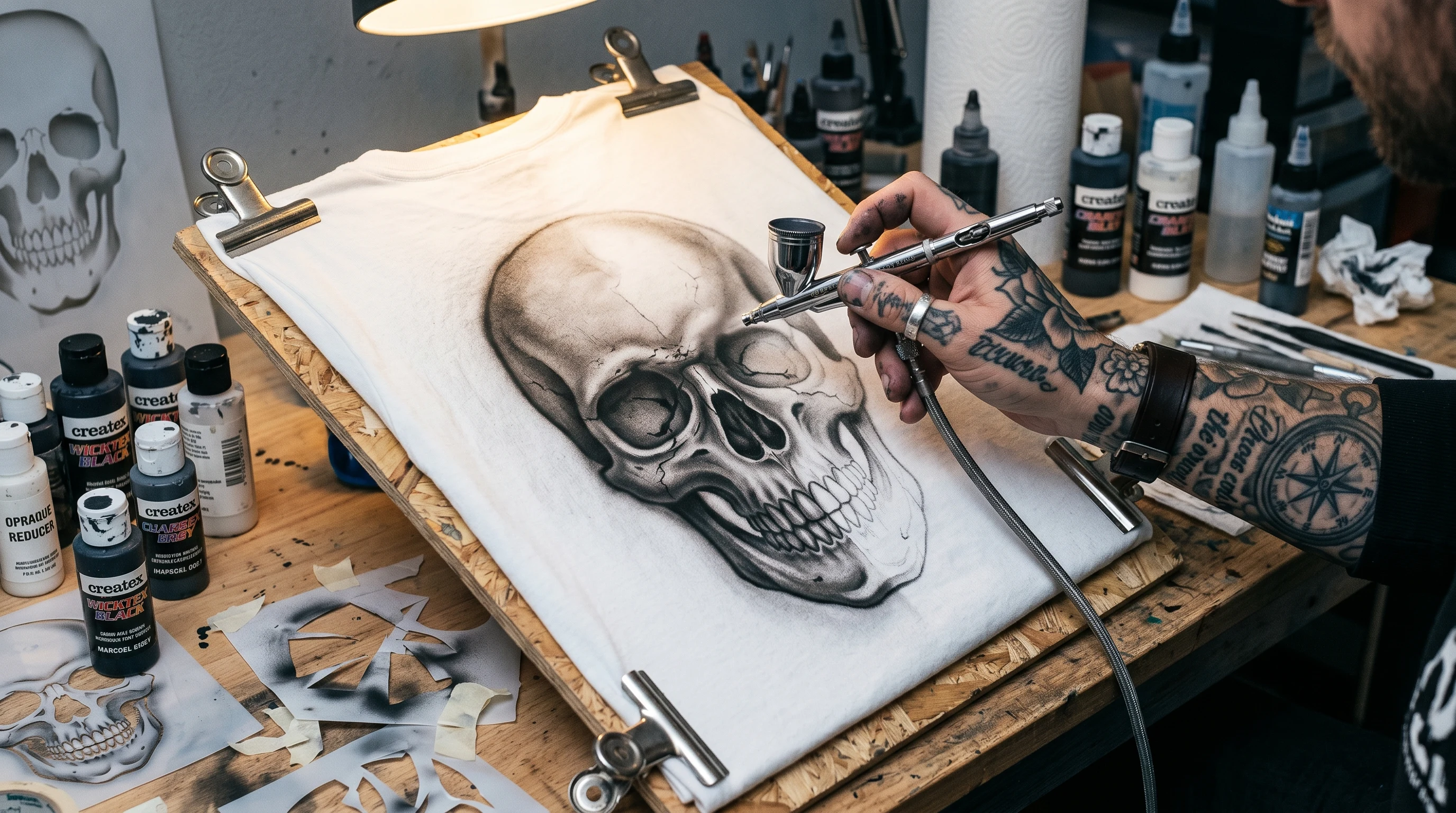
T-shirt airbrushing is having a major revival. Custom sneakers, streetwear, event merchandise, and one-of-a-kind wearable art are driving a new generation of fabric airbrush artists. But T-shirt work has different requirements than model painting or illustration, you need larger coverage, textile-specific paints, and a setup that handles the demands of fabric.
I’ve airbrushed on fabric alongside fine art and automotive work for years, and the equipment needs are genuinely different. Here’s what actually works for T-shirt art in 2026.
Fabric is a specialist case. For everything else, the best airbrush guide ranks the same brushes across budgets.
Quick Picks
| Airbrush | Type | Needle | Price tier | Best For |
|---|---|---|---|---|
| Iwata Eclipse HP-BCS | Siphon feed | 0.35mm | Mid-range | Industry standard for T-shirt work |
| Paasche Talon TG-3F | Gravity/siphon | 0.38mm | Mid-range | Versatile, great value, multiple heads |
| Badger Patriot 105 (in stock at SprayGunner) | Gravity feed | 0.5mm | Budget | Budget workhorse, forgiving |
| Iwata Eclipse HP-CS (also at SprayGunner) | Gravity feed | 0.35mm | Mid-range | Detail-oriented T-shirt art |
| Paasche VL | Siphon feed | Multiple | Budget | Classic T-shirt airbrush, great value |
What Makes T-Shirt Airbrushing Different
T-shirt work has specific demands that differ from other airbrush applications:
Larger coverage areas. You’re painting an entire shirt front (roughly 14” × 18”), not a 28mm miniature. This means you need an airbrush that can lay down paint efficiently over broad areas without constant refilling.
Textile paints are thicker. Fabric paints (Createx, Jacquard Airbrush Color, Wicked Colors) have different viscosity and binder chemistry than standard hobby acrylics. They’re formulated to flex with fabric and survive washing. A 0.3mm+ needle handles them best.
Higher working pressure. T-shirt work typically runs at 25–45 PSI, significantly higher than the 15–25 PSI used for miniatures. Higher pressure is needed to push textile paint through the airbrush and to atomize it properly at working distance.
Color changes happen frequently. Most T-shirt designs use multiple colors, and speed matters, especially at events or when running a business. Your setup needs to accommodate fast color swapping.
Heat setting is required. Unlike most airbrush applications, fabric paint needs heat setting (iron, heat press, or heat gun) to become permanent and washable. This is a post-painting step, not an airbrush consideration, but it’s essential to know.
The Siphon Feed vs Gravity Feed Debate for T-Shirts
This is the biggest equipment decision for T-shirt artists. Both work, but they serve different workflows.
Siphon Feed: The Traditional T-Shirt Choice
Siphon feed airbrushes are the traditional choice for T-shirt work for good reasons. Large paint bottles (1–3 oz) mean less frequent refilling. You can pre-mix colors in individual bottles and swap bottles instantly, no cleaning between colors if each bottle holds a different color. This is huge for production work or event airbrushing where speed matters.
The classic T-shirt artist setup: One siphon feed airbrush with 8–12 pre-mixed color bottles. Grab the color you need, snap on the bottle, spray, swap to the next color. At events, this speed is the difference between serving 20 customers per hour and 40.
Gravity Feed: For Detail-Oriented T-Shirt Art
If your T-shirt art emphasizes fine detail, portraits, realistic designs, complex shading, a gravity feed airbrush gives you more control. The lower operating pressure and finer atomization produce smoother gradients and tighter lines.
The trade-off is smaller paint capacity and slower color changes (dump, flush, refill vs. just swapping bottles).
The Two-Airbrush Solution
Many professional T-shirt artists use both:
- Siphon feed for backgrounds, large fills, and broad color work
- Gravity feed for detail work, fine lines, and finishing touches
This isn’t just for pros, if you’re serious about T-shirt art, a second airbrush is a worthwhile investment once you’ve outgrown a single tool.
Recommended Airbrushes
Iwata Eclipse HP-BCS: INDUSTRY STANDARD
Type: Siphon feed | Needle: 0.35mm
The siphon-feed version of the legendary Iwata Eclipse. Same build quality, same smooth trigger, same reliable spray pattern, but with bottom-feed bottle capability. The 0.35mm needle balances detail and coverage perfectly. This is the airbrush you’ll find in professional T-shirt booths worldwide.
Why it’s #1: The Eclipse name isn’t just marketing. This airbrush delivers consistent, reliable performance session after session. The spray quality at T-shirt working pressures (30–40 PSI) is excellent, and the machining quality means it tolerates the demands of daily production use.
Paasche Talon TG-3F: BEST VALUE
Type: Gravity feed (siphon adapter available) | Needle: 0.25mm, 0.38mm, 0.66mm (3 heads included)
The Talon ships with three spray heads, giving you fine detail (0.25mm), general work (0.38mm), and broad coverage (0.66mm) in one package. For T-shirt work, the 0.38mm is your daily driver and the 0.66mm is excellent for fast background fills.
Value proposition: Three airbrush capabilities for the price of one. The Talon also has excellent build quality. Paasche has been making airbrushes in the USA since 1904.
Note: Paasche uses proprietary hose fittings. You’ll need their hose or an adapter for standard 1/8” BSP hoses.
Badger Patriot 105: MOST FORGIVING
Type: Gravity feed | Needle: 0.5mm
The Patriot’s 0.5mm needle handles textile paints with minimal thinning and zero fuss. It sprays reliably, cleans easily, and forgives imperfect paint consistency. For someone learning T-shirt airbrushing, this removes the most common frustration, clogging and sputtering caused by slightly thick paint.
Limitation: The 0.5mm needle is less capable of fine detail than 0.3–0.35mm options. For portraits and precision work, you’ll want a finer airbrush eventually.
Iwata Eclipse HP-CS: DETAIL T-SHIRT ART
Type: Gravity feed | Needle: 0.35mm
If your T-shirt art leans toward detailed portraits, realistic designs, or intricate lettering, the gravity-feed Eclipse gives you the control that siphon feed can’t match. The 0.35mm needle produces fine lines when you need them and can still cover broader areas with proper technique.
Paasche VL: BUDGET CLASSIC
Type: Siphon feed | Needle: Multiple sizes available
The Paasche VL has been a T-shirt shop staple for decades. It’s simple, reliable, and affordable. The siphon feed design works perfectly with pre-mixed bottle colors, and the available spray head options let you customize for your workflow.
It’s not as refined as the Iwata Eclipse, the trigger feel is stiffer and the atomization isn’t as fine, but for the price, it’s an excellent production tool.
Textile Paints: What to Spray
Not all airbrush paints work on fabric. You need paints specifically formulated for textiles, they contain flexible binders that move with the fabric and withstand washing after heat setting.
Recommended Textile Airbrush Paints
Createx Airbrush Colors (also at SprayGunner). The industry standard for T-shirt artists. Available in transparent, opaque, fluorescent, pearl, metallic, and iridescent formulas. Water-based, low-odor, and available in large bottles (2 oz to 1 gallon). Thin with Createx 4012 Reducer for optimal spray performance.
Createx Wicked Colors (also at SprayGunner). Higher pigment concentration than standard Createx. Excellent for detailed work and designs that need strong color on dark shirts (use white opaque base first on dark fabrics).
Jacquard Airbrush Color. Originally formulated for textiles. Exceptional durability and wash resistance. Sprays well out of the bottle with minimal thinning. Soft hand feel on fabric. Available in transparent, opaque, metallic, and fluorescent.
Createx Auto Air Colors. Technically automotive paint, but many T-shirt artists swear by the Auto Air line for its high pigmentation and excellent adhesion. Requires heat setting for fabric permanence.
Paint Tips for T-Shirts
White shirts are easiest. Transparent and opaque colors both show well on white or light-colored fabric with no base coat needed.
Dark shirts need a white base. Airbrush paints are typically transparent or semi-opaque. On black or dark shirts, spray a white opaque base first (Createx Opaque White), let it dry, then apply your design colors over the white. Without this step, colors appear muddy and dull.
Heat set everything. After painting, wait at least 30 minutes for the paint to air dry, then heat set using a heat press (350°F for 35 seconds) or household iron (medium-high heat, 2–3 minutes through parchment paper or from the reverse side). Without heat setting, paint washes out.
Pre-wash new shirts. New shirts have sizing and chemical finishes that can prevent paint adhesion. Run them through one wash cycle without fabric softener before painting.
Fabric Prep and Heat-Setting Checklist
Most failed fabric jobs come from prep and curing, not from the airbrush. Work through it in this order:
- Choose the fabric. Cotton and cotton-rich blends take textile paint best. 100% polyester and slick sportswear fabrics hold paint poorly and can feel stiff or lose color in the wash, so test a scrap before committing to a finished garment.
- Pre-wash, dry, and iron flat. Wrinkles show up as uneven coverage once the paint is on.
- Put a barrier inside. Slide cardboard or a plastic sheet inside the shirt or bag so paint can’t soak through to the back layer.
- Hold the fabric taut. Tape or pin the edges to a board. Loose fabric shifts in the air stream and ruins stencil edges.
- Test on a scrap of the same fabric. Check the color, how the paint feels once dry, and whether it survives a wash.
- Spray light coats and build up. Soaking the fabric makes colors bleed and leaves the print stiff. Mist thin layers and let each one flash-dry before the next.
- Air dry, then heat set. Use the times above: at least 30 minutes of drying, then a heat press or iron. Keep the iron moving, use no steam, and heat through parchment paper or from the reverse side so the paint doesn’t stick to the iron.
- Wash with care. Check the paint label for how long to wait before the first wash. Then wash inside out in cold water on a gentle cycle and skip bleach.
Beyond T-Shirts: Other Fabrics and Surfaces
The same paints and heat-setting work on other fabric items, with a few adjustments:
- Canvas shoes and tote bags. Tightly woven cotton canvas is one of the easiest surfaces to paint. Stuff shoes with paper or plastic to keep their shape, and mask soles, laces, and seams with tape.
- Denim. The thick weave soaks up paint. Build the color in thin coats, and expect to need a white base under light colors on dark denim.
- Hoodies and fleece. The fuzzy surface scatters the paint, so edges look soft. Press tape or stencils down firmly and test first.
- Stretch fabrics. Paint can crack where the fabric stretches a long way. Keep designs away from high-stretch areas and test on a scrap.
- Stencils on fabric. Freezer paper ironed on shiny-side down makes a clean mask that peels off without residue. For reusable designs, the stencil creator turns a photo into cut-ready layers.
The Complete T-Shirt Setup
Here’s everything you need for a functional T-shirt airbrushing station:
Essential Equipment
| Item | Recommendation | Price tier |
|---|---|---|
| Airbrush | Iwata Eclipse HP-BCS or Paasche Talon | Mid-range |
| Compressor | Any compressor with tank, 40+ PSI | $80–150 |
| Air hose | Braided hose with appropriate fittings | $10–20 |
| Textile paint set | Createx Airbrush Colors starter set | Budget |
| White opaque paint | Createx Opaque White (large bottle) | Budget |
| Heat press or iron | Heat press preferred; iron works | $30 (iron) to $200+ (press) |
| Shirt board | Cardboard cut to shirt size or commercial shirt board | $5–15 |
| Masking materials | Frisket film, stencil material, or painter’s tape | $10–20 |
| Respirator | Half-face respirator with P100/OV filters | $25–35 |
Total starter investment: ~$300–500
Nice to Have
- Spray booth or fan. Textile paints produce overspray; ventilation matters for indoor work
- Pre-cut stencils. For lettering, borders, and repeated design elements
- Quick-disconnect fittings. Faster hose attachment/detachment
- Second airbrush. One siphon for fills, one gravity for detail
- Shirt platen or easel. Holds shirts flat and at a comfortable working angle
Frequently Asked Questions
What is the best airbrush for T-shirts?
The Iwata Eclipse HP-BCS (siphon feed) is the industry standard for T-shirt airbrushing. Its 0.35mm needle handles textile paints well, the siphon feed allows large bottle capacity and quick color changes, and Iwata’s build quality ensures reliable performance. For budget-conscious beginners, the Paasche Talon or Badger Patriot 105 are excellent alternatives.
Do I need a siphon feed airbrush for T-shirts?
Not necessarily. Gravity feed airbrushes work well for T-shirt art, especially for detailed designs. Siphon feed is preferred for production work and events because pre-mixed color bottles allow instant color changes. For hobby or occasional T-shirt painting, gravity feed is perfectly adequate.
What paint do I use for airbrush T-shirts?
Use textile-specific airbrush paints such as Createx Airbrush Colors, Jacquard Airbrush Color, or Createx Wicked Colors. These are formulated with flexible binders that survive washing and maintain a soft feel on fabric. Standard acrylic airbrush paints (Vallejo, Tamiya) are not designed for fabric and will crack or wash out.
How do I make airbrush paint permanent on T-shirts?
Heat setting. After the paint is fully air-dried (at least 30 minutes), apply heat using a heat press at 350°F for 35 seconds, or iron on medium-high heat for 2–3 minutes through parchment paper. Heat setting activates the binders in textile paint, making the design permanent and machine-washable.
Can you airbrush on polyester?
It’s difficult. Polyester and other slick synthetics don’t absorb textile paint the way cotton does, so the paint can sit on the surface, feel stiff, and fade in the wash. Cotton and cotton-rich blends are the reliable choice. If you must paint polyester, test a scrap first, heat set it, and wash-test it before painting the real item.
How do I wash an airbrushed T-shirt?
After the paint is heat set and the paint maker’s waiting time has passed, wash it inside out in cold water on a gentle cycle, and avoid bleach. Hang it to dry or tumble on low. Washing inside out protects the design from rubbing against other clothes.
What PSI should I use for airbrushing T-shirts?
Typically 25–45 PSI, depending on the paint and technique. Broad fills and backgrounds work well at 35–45 PSI. Detail work and fine lines benefit from lower pressure, around 25–30 PSI. Start at 30 PSI and adjust based on how the paint flows and atomizes.
Can I airbrush on dark T-shirts?
Yes, but you need to spray a white opaque base layer first. Airbrush paints are typically transparent or semi-opaque, so they appear muddy on dark fabric without a light base underneath. Spray Createx Opaque White, let it dry, then apply your design colors over the white for vibrant results.
- Best Airbrush for Beginners 2026. General recommendations
- Gravity Feed vs Siphon Feed. Feed type comparison
- How to Choose the Right Airbrush Paint. Paint guide including textile paints
- How to Thin Acrylic Paint for Airbrush. Createx thinning ratios
- Essential Airbrush Accessories & Tools. Full accessory checklist
- Best Airbrush Kit for Beginners. Kit options for T-shirt work