How to Choose an Airbrush Gun: Action, Feed and Mix Explained
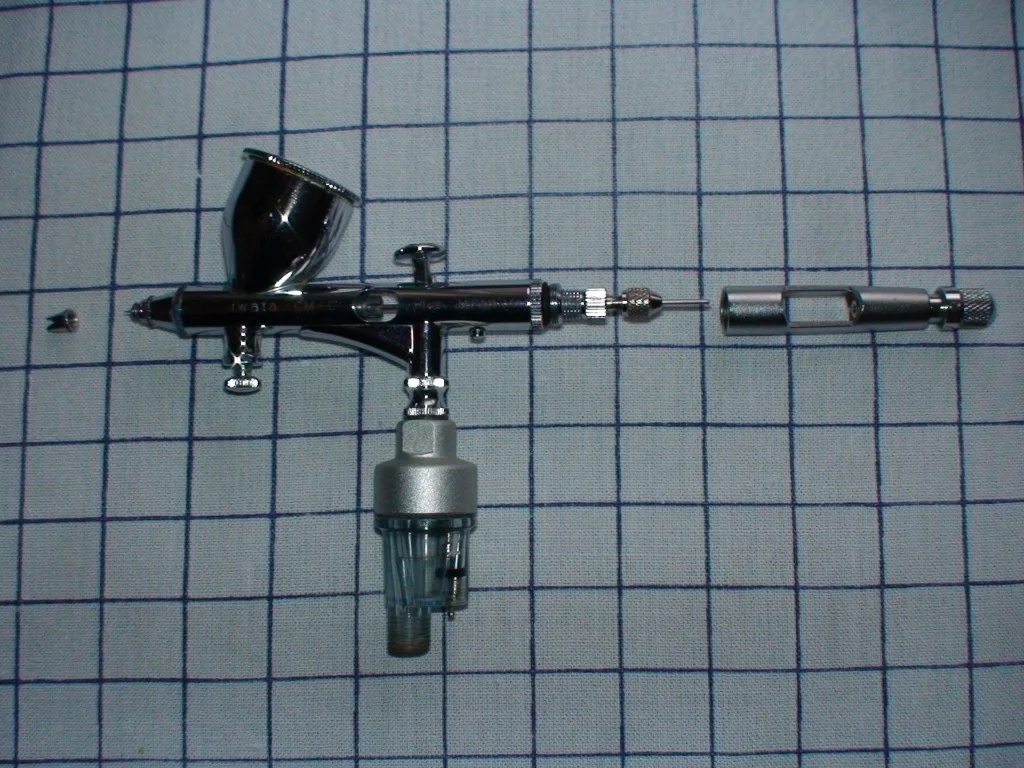
An airbrush gun (also written air brush gun, or called an airbrush spray gun or simply an airbrush) is the pen-sized spray tool at the heart of airbrushing. Three choices decide which one suits you: action (single or dual), feed (gravity, siphon or side cup) and mix (internal or external).
Short answer: for a first airbrush gun, buy a dual-action, gravity-feed, internal-mix model with a needle around 0.3 to 0.5 mm. It handles fine lines and medium coverage, wastes little paint and is easy to clean. Choose something else only for a specific job:
- Single-action: the trigger controls air only and paint flow is preset, so it is easy to learn. Fine for basecoating models, limiting for freehand art.
- Siphon (bottle) feed: holds far more paint for covering big areas such as T-shirts or car parts, but leaves more paint in the bottle and tube when you clean or change colour.
- External mix: cheap and tolerant of thick paint, but the spray is too coarse for detail work.
Below is what each option means in practice, then advice from working artists on what to buy first. For specific models by budget, from $50 starters to professional gear, see the best airbrush guide, and remember you will also need an air compressor and airbrush paints.
Airbrush Gun Types Explained
Action: Single vs Double
By the action we recognize two types: single and double action airbrush gun.
Single-Action (SA)
In this airbrush gun the trigger controls airflow only. Paint volume is constant but can be adjusted by the depth of needle inside the nozzle. Mostly there is a screw at the rear of airbrush to set that depth.
Double-Action (DA)
Here one trigger controls both - the airflow and the paint flow. Pushing the trigger down lets air to flow and when you pull the trigger backwards paint will come into mixing chamber. The amount of paint depends on how far you pulled the trigger backwards. 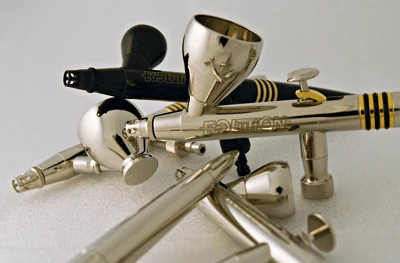 That means that you can change the amount of paint on the fly (no stopping, no adjusting). Double-action requires more skills and time to get used to it as you have to do two things at once (regulate the airflow and paint flow).
These airbrushes are good for detailed jobs and are very popular among scale modelers (but not all of them use double-action airbrushes as for their purpose single-action could be good enough).
Feed: Gravity, Siphon and Side Cup
This describes the way we feed our airbrush gun with paint.
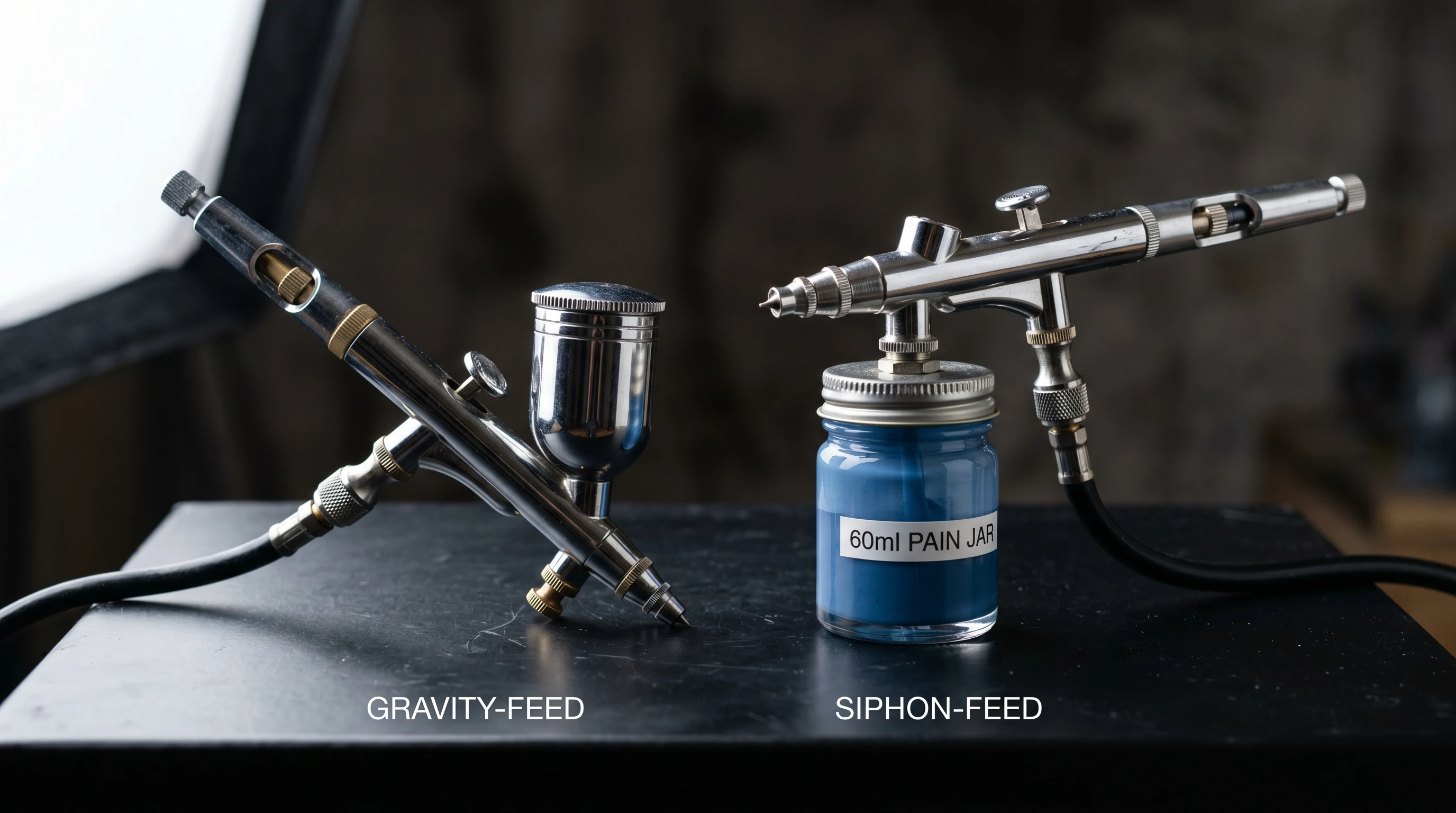
Gravity feed (GF)
These airbrushes have a pain cup on the top or side of their body. The function is easy as it is based on the Earth gravity which pushes the paint down into mixing chamber where it gets mixed with air and sprayed.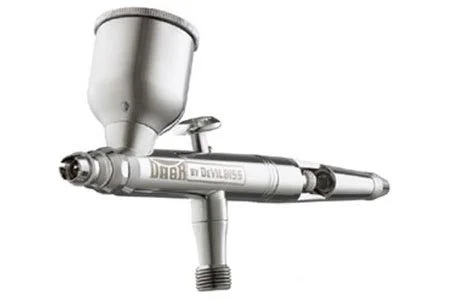
Gravity feed airbrush doesn’t need as high pressure as the siphon feed. This is big advantage when you paint fine-lines.
Siphon feed (SF)
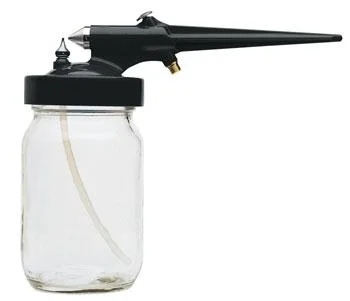 This one has a bottle on the bottom (sometime it’s called bottom feed) and as you can get from the name it works on the principle that there is a tube inside the bottle that goes from airbrush gun body. Blown air over the tube pulls the paint up into the mixing chamber. Big plus for this type is capacity as the bottles used there are bigger than the cup used in gravity feed airbrushes. This is a huge advantage when painting big objects (no stops to refill).
Now when choosing between these two I want to give you some advises. Gravity feed cups can vary in sizes and some of this guns have a possibility to change the cup, some are permanently fixed to the body (most cases). Some come with a lid on the cup and some don’t. So which one do you choose, depends on the purpose of your airbrushing. If you’re going to paint small details you’ll probably prefer smaller cup, if you use acrylic paint you would prefer a cup with a lid. It does not mean that you have to buy exactly this, you can always make a lid (see here, this is just a single example). For some of siphon feed airbrush guns you can buy a cup that can be mounted to the side of airbrush. This can cut the pressure needed to use it. But not every gun has this functionality.
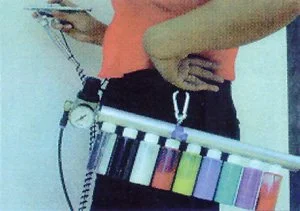
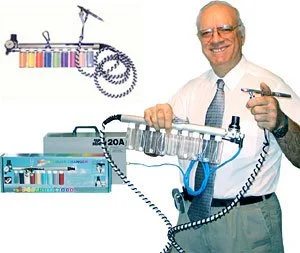
Maybe you’d want to check a really interesting tool for siphon feed airbrushes called “SPECTRUM 2000” that allows you to have up to nine bottles of paint connected at the same time. I’ve never tried this, so this is just a note that siphon feed airbrush gun can have some advantage but I don’t know if it’s good.
Hybrid feed (HF)
As name says it is a hybrid of the two types above. Some guns have a rotation switch on their body so you can switch between cup and bottle. 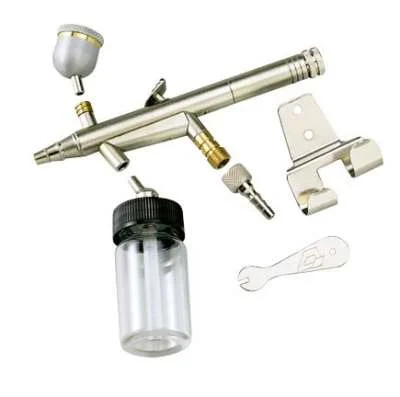
Some airbrush guns with bottom feed can have a cup on the top that is used simultaneously with the bottle if you need to raise a paint volume (assist feeding).
Mix: Internal vs External
Another two types which can categorize your airbrush depending on how it mixes the paint with air are Internal and External mix airbrush guns.
Internal mix atomizes the paint inside the body of airbrush gun, external outside the body.
Good example of external mix type of airbrush gun is Paasche H.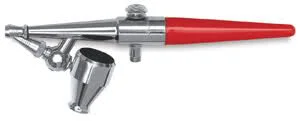 It has the paint nozzle below the airbrush body where it gets atomized, so the body stays clean as there is almost no paint inside it at all. But the internal mix type has usually finer finish than external one. If you prefer details you should choose the internal mix one and live with the fact that you have to clean it more often than external mix gun.
This is probably all the types of airbrush guns that exists at the present day.
The other things to have in mind when choosing the airbrush gun is nozzle and needle. Most of the guns can have this changeable. It depends on demands of your work. This is not always the case, even if the first thing that comes to your mind is that changing your nozzle and needle to smaller size will give you finer details and lines. Most of the professionals are going to admit that it doesn’t have to be true. The last width of lines depends on the position of the needle to the nozzle and of course the closer you get the nozzle to the surface of your painting the finer the line is going to be. And this depends on the air pressure and user abilities as well.
Choosing Yours
Which Airbrush Gun Should You Buy?
Very difficult to tell. First of all you have to choose the type from all the examples I have mentioned above.
-
Is it going to be single or double-action airbrush
-
what kind of feed do you prefer
-
look around for the type of mixing that you want
Now is the right time to present a few advises from professionals, that I’ve been collecting for last few weeks from my Facebook fan page, twitter and other sources:
-
My first airbrush was a cheap plastic Aztec that come in model kits. I didn’t know a lot about brushes back then and never could get it to work well until I purchased an Iwata HP-CS, than I understood what makes the angels sing. A new world opened up. I was finally able to paint my masterpieces with precision control & much less fuss with the brush.
-
The right tools & equipment are essential. My advice to anyone looking to start would be to make the investment in the beginning. It will spare you the time & frustration in the long run.
-
Paasche SA was a good start, I was just mucking around with it one day for fun and discovered I really enjoyed it. Now I have a Harder & Steinbeck Infinity and can’t stop airbrushing.
-
The right tools make all the difference. There was a huge difference between the SA Paasche and the Iwata HP-CS, I practically had to retrain myself all over again learning to control the DA after starting with a SA.
-
DO NOT BUY A SINGLE ACTION AIRBRUSH unless you just want to paint models. They have their uses but make it very difficult to achieve some strokes and techniques for artistic painting.
-
Never waste money on cheap airbrushes, but you don’t need to spend big money either for something like the Iwata CM C+ .
-
I don’t like external mix after my Paasche, and siphon feeds waste a lot of paint when you clean or change colour, so if you are a newbie and only doing small artworks, then it’s not a good idea. Gravity feed is definitely the one to go for someone new
-
My first was a very expensive Badger. All I did was fight the whole time I tried. They are fussy and I ended up getting a Master g44 ( smooth :))
-
I had the opportunity to use the new Harder & Steenbeck “Infinity Two-in-One” airbrush - in all honesty I have to say I wasn’t prepared for it to be as good as it is! This brush deserves to be viewed as a totally unique experience. For an Artist on a budget who needed to be able to work across a full range of venues from Automotive or Fine Art, to Textile/Wearable Art, this airbrush would be a best buy. I am VERY impressed by this airbrush.
-
I’ve been airbrushing for 18 years and I have never seen an assembly that large pull consistently fine lines like that. After experimenting for a time I began my painting. I used the Infinity and absolutely loved working with it. The features are a dream! It performed beautifully and did absolutely everything that I needed it to do with an effortless consistency. I am extremely impressed with this airbrush, and would definitely recommend it to anyone. I also think that this brush would be ideal for beginning airbrushists because it is so easy to use and leaves lots of room to grow as the user progresses.
-
Start out with what you can afford but realize that you get what you pay for. Don’t be cheap, purchase the recommended paints and thinners. “Practice. Practice. Practice” is the key to perfection
I’m not promoting any brands here. These are professional advices and if you don’t believe them do some background research and find some more reviews.
If you check those links, the prices vary a lot. IWATA brand definitely belongs to a top brand of airbrushes out there, even if you think that they are too expensive, any professional will tell you that they have reasonable prices. My Bro uses Iwata Custom Micron CM-C Plus (also at SprayGunner) and he is more than satisfied. His first airbrush was BD180 Gravity feed Double-action, but after he bought Iwata the whole experience has changed. He commented on difference between these two as “Heaven and Hell” I think that you get this. Here are some pictures of his gun.
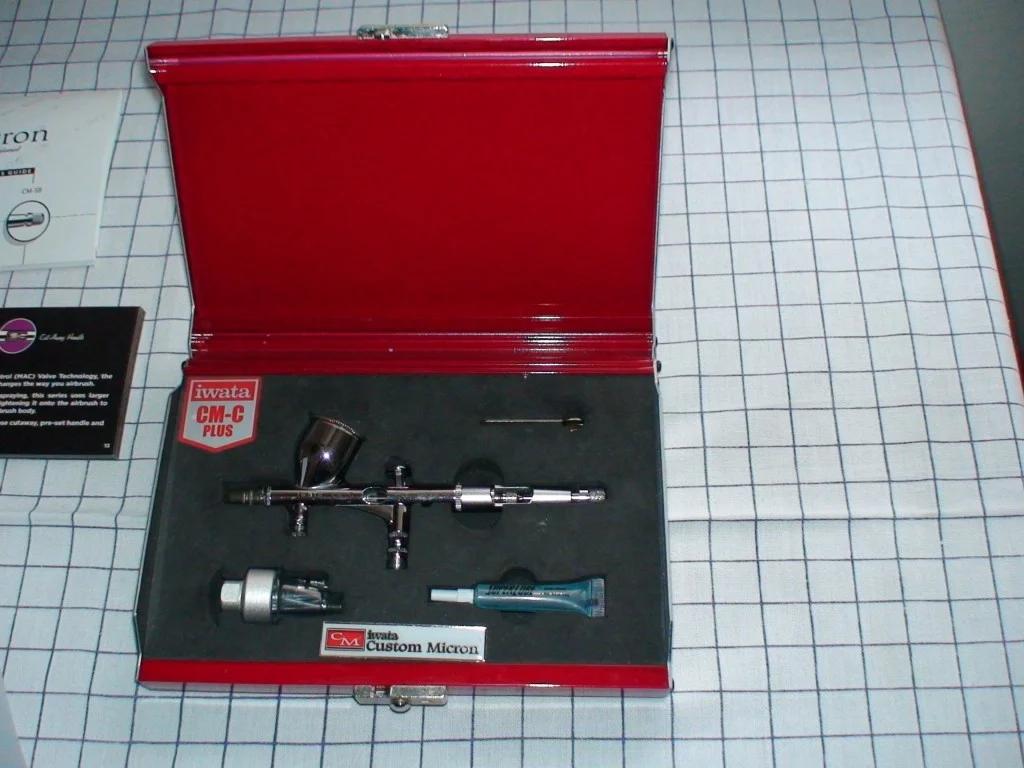
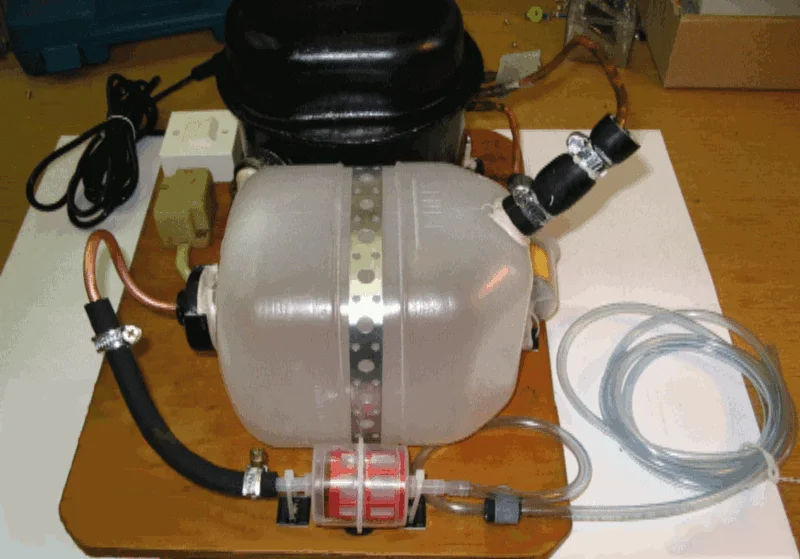
Which one you’re going to buy will depend mostly on your financial situation. Don’t forget that besides airbrush you have to get air compressor or build one (see here or here).
At this point I have no more words to say and I hope that this article will help you a little. I’m counting on professionals who won’t stay in shadow and will share their experiences in comments. This is it for airbrush guns, next time I want to say something about air compressors.
Here are some more results that I collected from airbrushdoc audience:
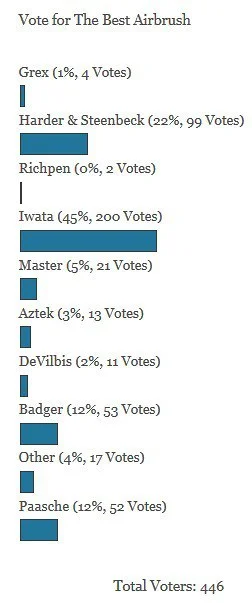
Source: Facebook fun page, Wolf SongStudio