Gravity Feed vs Siphon Feed Airbrush: Which Type Do You Need?
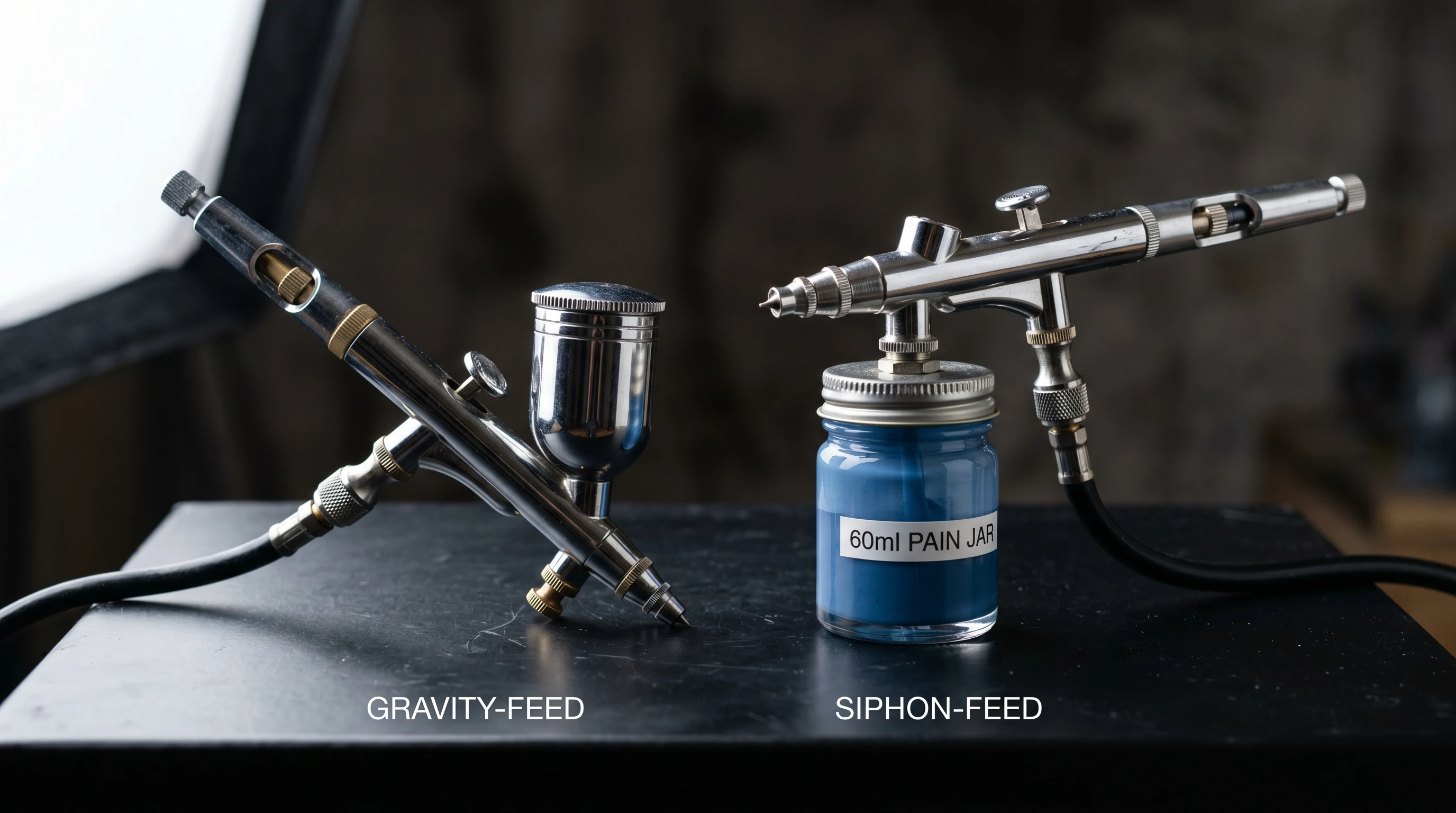
Every airbrush gets paint from its cup or bottle to the nozzle in one of two ways: gravity pulls it down from a cup on top, or air suction pulls it up from a bottle below. This single design difference affects how you work, what you can paint, and how much cleanup you’ll deal with.
Here’s the straightforward comparison, including the lesser-known side feed option that splits the difference.
The Quick Answer
For most people: gravity feed. It works at lower air pressure, uses less paint, handles fine detail better, and is easier to clean. About 80% of airbrush users today use gravity feed, and there’s a reason every beginner guide recommends it as the default.
For specific applications: siphon feed. If you spray large areas, use one color for extended periods, or work with thick media, siphon feed has real advantages that gravity can’t match.
How They Work
Gravity Feed (Top Feed)
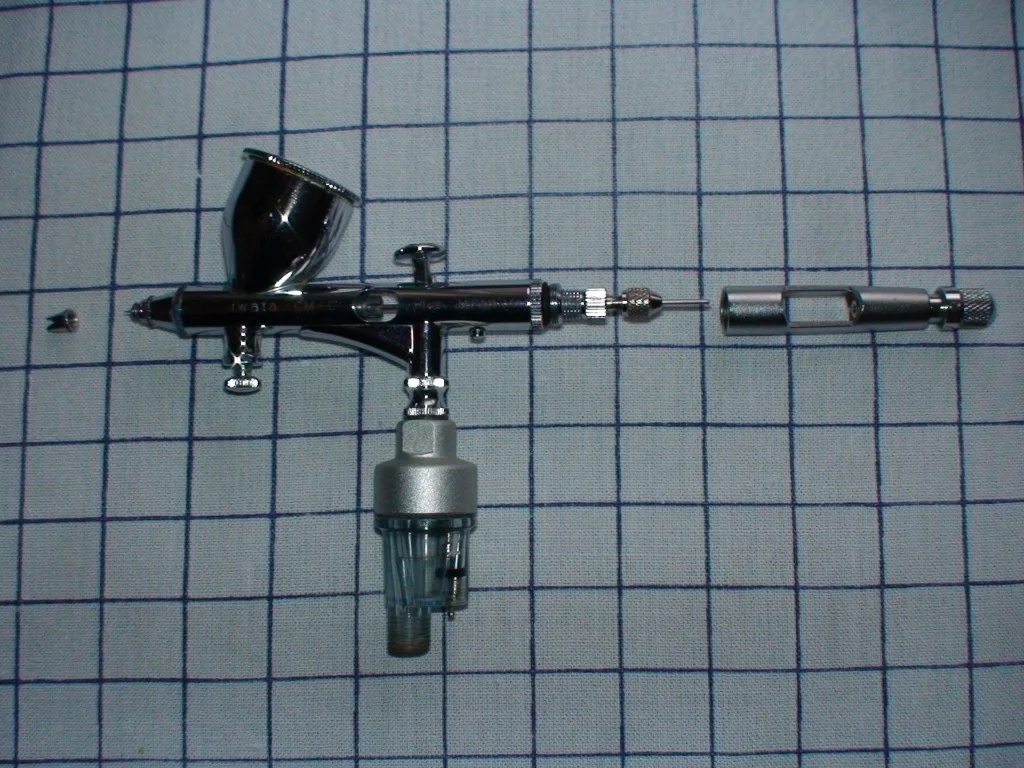
A cup sits on top of the airbrush body, usually attached directly to the airbrush. Paint in the cup flows downward into the paint channel by gravity, no suction needed. The compressed air then atomizes this paint at the nozzle.
Because gravity does part of the work, gravity feed airbrushes require less air pressure to draw paint through the system. This means finer atomization, softer spray patterns, and better control at low PSI.
Siphon Feed (Bottom Feed)
A bottle or jar attaches to the bottom of the airbrush via a tube called a siphon tube (or dip tube). When compressed air flows through the airbrush, it creates a vacuum effect (Venturi principle) that pulls paint upward through the tube and into the airstream.
Because the air has to work harder, pulling paint up against gravity, siphon feed requires higher air pressure. This produces a stronger spray that’s better suited for coverage work but less ideal for fine detail.
Side Feed
A smaller cup attaches to the side of the airbrush body, usually on a swivel mount that allows rotation. Paint flows partly by gravity and partly by suction, depending on the angle you’re holding the airbrush.
Side feed is a niche option that combines some advantages of both designs but isn’t widely popular. It’s favored by some illustration artists who want the ability to rotate the cup out of their line of sight.
Head-to-Head Comparison
| Feature | Gravity Feed | Siphon Feed | Side Feed |
|---|---|---|---|
| Paint capacity | 2–15ml (typical cup) | 30–90ml (jar/bottle) | 2–7ml (small cup) |
| Operating PSI | 15–30 PSI typical | 25–50 PSI typical | 15–35 PSI typical |
| Fine detail ability | Excellent | Limited | Good |
| Large area coverage | Slow (small cup, frequent refills) | Excellent (large bottle, continuous spray) | Slow |
| Paint waste | Minimal (small cups) | Higher (paint left in bottle/tube) | Minimal |
| Cleaning speed | Fast (open cup, easy access) | Slower (bottle, tube, siphon assembly) | Moderate |
| Color changes | Fast (dump cup, flush, refill) | Slow (empty bottle, clean tube, refill) | Fast |
| Thick paints | Can struggle (gravity alone may not push thick media) | Better (suction helps pull thick paint) | Moderate |
| Visibility | Cup may partially block view above | No obstruction | Cup can be rotated away |
| Weight balance | Top-heavy when full | Bottom-heavy when bottle attached | Slight side weight |
| Price range | $$ | $ to $$ | $$ to $$$ |
When to Choose Gravity Feed
Gravity feed is the right choice for the majority of airbrush users. Choose it if:
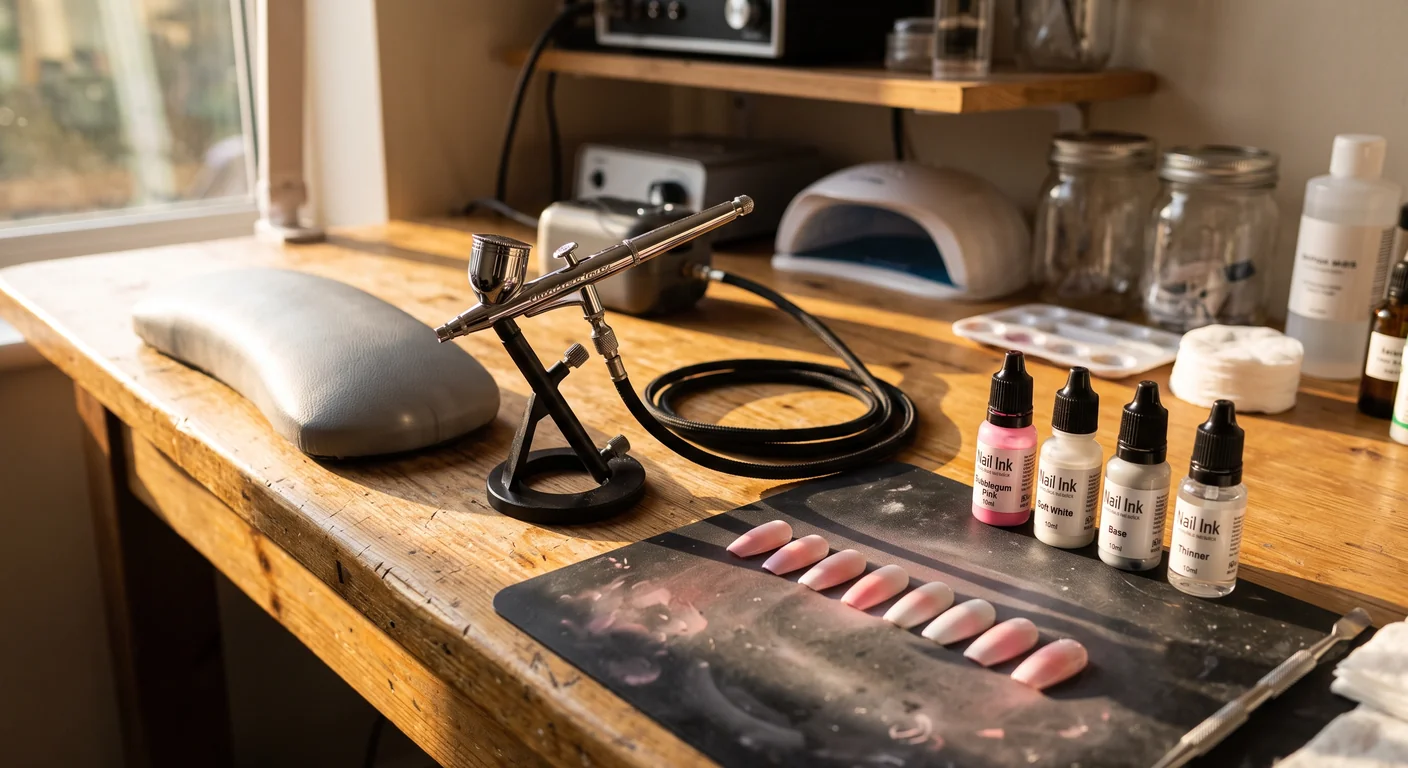
You do detail work. Miniatures, scale models, illustration, fine art, nail art, makeup, any application where precision matters. The lower operating pressure and finer atomization give you more control over line width and paint density.
You change colors frequently. With a gravity cup, color changes take 30–60 seconds: spray remaining paint onto a towel, add cleaner, flush, add new color. With siphon feed, you’d need to empty the bottle, clean the siphon tube, clean the bottle, then refill, a multi-minute process every time.
You work on small-to-medium projects. A typical gravity cup holds 5–10ml of paint. That’s enough for several miniatures, a 1/48 scale model, or a significant amount of illustration work without refilling. If your projects don’t require continuous spraying of large volumes, gravity capacity is sufficient.
You value easy cleanup. The open-top cup is the easiest airbrush component to clean. Wipe with a cotton swab, add cleaner, flush, done. No bottles to wash, no tubes to clear, no hidden paint buildup in siphon assemblies.
You’re a beginner. Gravity feed is more forgiving at every level, it works at lower pressure (less overspray), uses less paint (less waste while learning), and cleans faster (less frustration between practice attempts).
Recommended gravity feed airbrushes:
- Iwata Eclipse HP-CS (0.35mm), the benchmark all-rounder
- Harder & Steenbeck Evolution 2-in-1, maximum versatility
- H&S Ultra 2024, best beginner option
- Badger Patriot 105, forgiving workhorse
When to Choose Siphon Feed
Siphon feed has specific advantages that gravity feed cannot replicate. Choose it if:
You spray large areas continuously. T-shirts, murals, automotive work, body painting, scenic backdrops, any project where you’re spraying for extended periods without stopping. A 60ml or 90ml siphon bottle lets you spray far longer before refilling than a 7ml gravity cup.
You use one color at a time for extended periods. If your workflow involves setting up one color and spraying it across many items (production T-shirt work, repetitive automotive touches, assembly-line priming), siphon feed’s large capacity is a genuine time saver. The slow color-change speed doesn’t matter if you’re not changing colors often.
You spray thick or textured media. Some media, heavy body paints, certain textile paints, some special effects products, are too thick for gravity feed alone to push through. Siphon feed’s active suction pulls thicker material more reliably. (Though proper thinning usually solves this for gravity feed too.)
You need multiple pre-mixed colors ready to go. With siphon feed, you can pre-mix colors in several bottles and swap bottles on the airbrush as needed. This is popular in T-shirt and automotive art studios where artists have a dozen colors pre-mixed in labeled bottles, grabbing whichever they need.
Recommended siphon feed airbrushes:
- Paasche VL, classic versatile siphon feed
- Iwata Eclipse HP-BCS, siphon version of the Eclipse
- Badger Crescendo, large-area workhorse
The Common Myth: “Siphon Feed Is Better for Beginners”
You’ll occasionally see this claim, usually with the reasoning that siphon feed’s larger bottle means less frequent refilling. While technically true, this ignores every other factor:
- Gravity feed is easier to clean (faster learning loops)
- Gravity feed works at lower pressure (less overspray, less waste)
- Gravity feed wastes less paint (important when experimenting)
- Gravity feed is more responsive (better trigger feedback for learning control)
The slight convenience of fewer refills doesn’t outweigh these advantages. Every modern airbrush teaching resource recommends gravity feed for beginners, and that recommendation is correct.
Can You Convert Between Types?
Generally, no. Gravity and siphon feed airbrushes are designed differently at a fundamental level, the paint channel routing, air passage geometry, and body machining are different. You can’t meaningfully convert one type to the other.
However, some airbrushes (notably the Paasche VL) offer both gravity and siphon attachments by including a small gravity cup that replaces the siphon bottle mount. This is a genuine dual-feed design, not a conversion, the airbrush was engineered for both from the start.
What About Side Feed?
Side feed airbrushes are uncommon but have a dedicated following among certain illustration and photo-realist artists. The cup mounts on the side of the body (usually with a rotating swivel) and can be positioned to the left, right, or angled to keep it out of the artist’s line of sight.
Advantages:
- Better visibility, cup doesn’t obstruct the view above
- Can work at any angle (gravity cup can spill if tilted too far)
- Swivel mount allows ergonomic customization
Disadvantages:
- Fewer models available
- Slightly more complex to clean than gravity
- Smaller cup capacity than gravity (typically)
- Less popular means less community support and fewer tutorials
Best for: Freehand illustration artists who work very close to their surface and need unobstructed visibility.
Frequently Asked Questions
Is gravity feed better than siphon feed?
For most applications, yes. Gravity feed airbrushes work at lower pressure, offer finer control, waste less paint, clean faster, and handle color changes more efficiently. Siphon feed is better only for specific scenarios: large-area coverage, thick media, and workflows where you spray one color for extended periods without changing.
Can I use a gravity feed airbrush for T-shirts?
Yes, but you’ll refill the cup more frequently than with a siphon feed bottle. For casual T-shirt work or single-shirt projects, a gravity feed works fine. For production work (spraying many shirts with the same design), siphon feed’s larger capacity saves time.
Why do gravity feed airbrushes work at lower pressure?
Because gravity assists paint flow. In a gravity feed, paint naturally falls from the cup into the paint channel, the air only needs to atomize it at the nozzle. In siphon feed, the air must create enough suction to pull paint upward against gravity AND atomize it. This extra work requires higher pressure.
Which is easier to clean, gravity or siphon?
Gravity feed, significantly. The open-top cup can be wiped, flushed, and refilled in under a minute. Siphon feed requires cleaning the bottle, the siphon tube, the bottle connection, and the internal passages, a longer process with more components.
Do professional artists use siphon feed?
Yes, in specific fields. T-shirt artists, automotive airbrush painters, body painters, and mural artists often prefer siphon feed for its large capacity and continuous spray capability. Fine art illustrators, miniature painters, and model builders overwhelmingly use gravity feed.
- Best Airbrush for Beginners 2026. Full airbrush recommendations
- Best Airbrush for Miniatures. Gravity feed models for detail work
- Airbrush Needle Sizes Explained. Needle size guide
- Best Airbrush Kit for Beginners. Starter kits (mostly gravity feed)
- Best Airbrush for T-Shirts. Siphon vs gravity for textile work