Airbrush Needle Sizes Explained: Which Size Do You Actually Need?
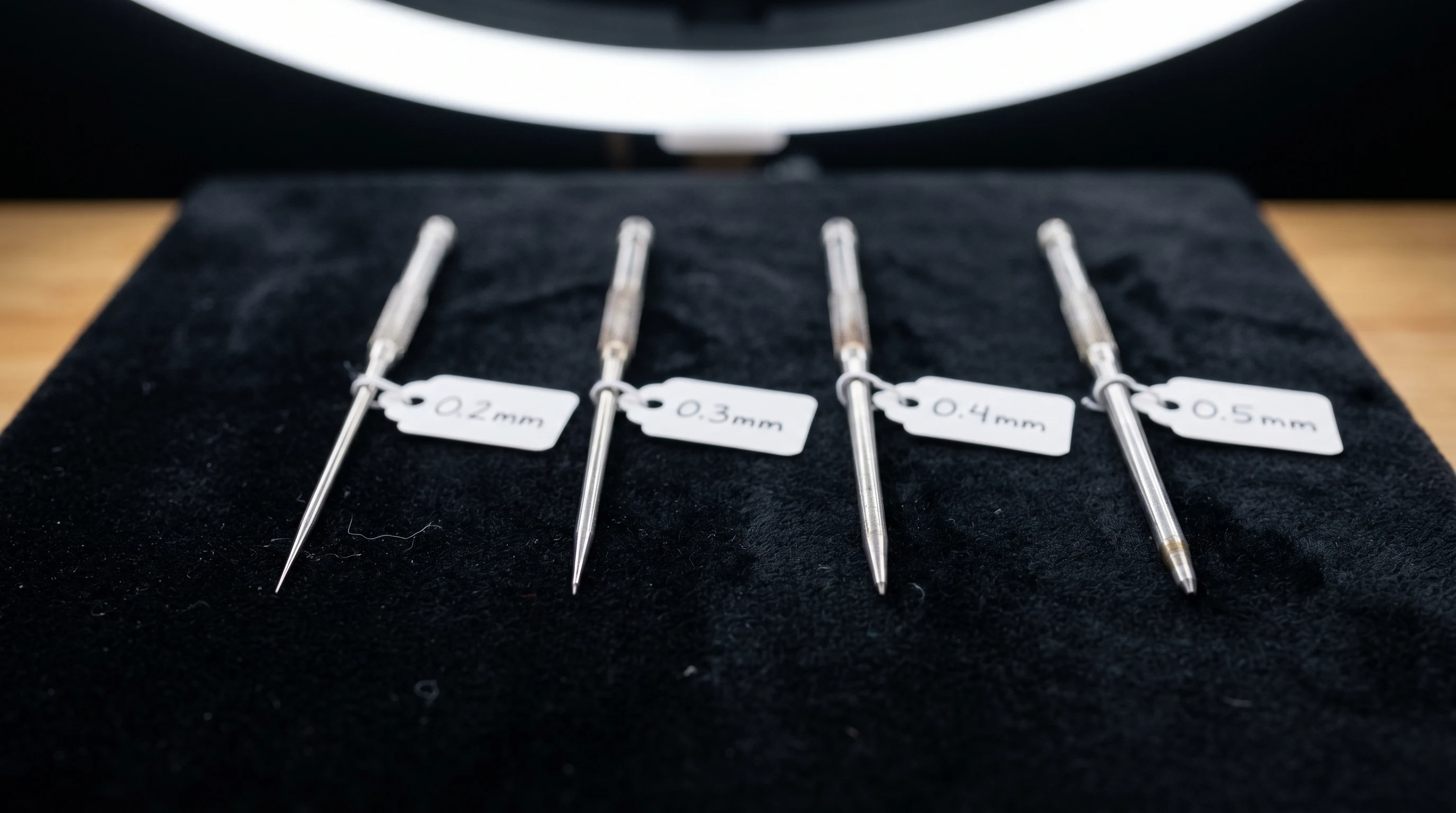
The needle size on your airbrush determines one fundamental thing: how much paint comes out. Smaller needle = less paint = finer lines. Larger needle = more paint = broader coverage. Everything else, spray width, detail capability, paint thickness tolerance, clogging tendency, flows from this one relationship.
That’s really it. But the specifics matter when you’re choosing an airbrush or deciding whether to buy a different needle/nozzle set. Here’s a clear breakdown of every common size and what it’s actually good for.
The Quick Reference Chart
| Needle Size | Category | Finest Line | Max Spray Width | Best For | Paint Thinning | Clog Risk |
|---|---|---|---|---|---|---|
| 0.15mm | Ultra-fine | Hair-thin | ~15mm | Competition miniatures, photo-realism, extreme detail | Heavy thinning required | Very high |
| 0.2mm | Fine | ~0.5mm | ~25mm | Miniatures, fine detail, illustration, small models | Significant thinning | High |
| 0.3mm | Medium | ~1mm | ~40mm | All-purpose, scale models, general hobby, learning | Moderate thinning | Moderate |
| 0.35mm | Medium | ~1.5mm | ~50mm | All-purpose workhorse, most popular beginner size | Moderate thinning | Moderate |
| 0.4mm | Medium-Large | ~2mm | ~60mm | Basecoating, priming, larger models, T-shirts | Light thinning | Low |
| 0.5mm | Large | ~3mm | ~80mm | Priming, basecoating, large coverage, thick paints | Minimal thinning | Very low |
Key insight: The “finest line” column shows the thinnest line possible at close range with good technique. The “max spray width” shows the widest pattern at normal working distance. Every needle can produce everything between these extremes by adjusting distance, pressure, and trigger pull.
Size-by-Size Breakdown
0.15mm: The Scalpel
This is the finest needle commonly available. It produces lines so thin they can simulate individual hairs, capillary veins, or scratches on a 28mm miniature. It’s used by competition painters and photo-realist illustrators who need the absolute finest control.
Reality check: A 0.15mm needle is demanding. It requires perfectly thinned paint (think ink consistency), immaculate cleaning after every color, and a steady hand at very close range. Any dried paint particle, any pigment clump, any hesitation in your technique shows immediately. This is not a beginner needle, it’s a specialist tool for experienced painters who’ve mastered everything else.
Found on: Harder & Steenbeck Infinity CR Plus (2-in-1 set), Iwata Custom Micron series
0.2mm: Fine Detail
The most popular needle size for miniature painters and fine detail work. A 0.2mm needle produces fine lines, clean dots, and tight color transitions while being slightly more forgiving than 0.15mm. It can handle slightly thicker paint and doesn’t clog quite as easily.
At close range (1–2 inches), you can achieve remarkable precision, sharp freehand lines, spot highlights, and controlled glazes. Pull back to 3–4 inches and you get a soft, diffused spray suitable for gentle color transitions and pre-shading.
Limitations: Covering large areas is slow. Priming even a single large model takes significantly longer than with a 0.4–0.5mm needle. Thick paints (heavy body acrylics, some primers) may struggle to flow through consistently.
Found on: Harder & Steenbeck Ultra 2024, H&S Evolution 2-in-1 (fine set), Badger Sotar 2020
0.3mm: The Sweet Spot
If you could only own one needle size, 0.3mm is the one most experienced airbrush users would choose. It balances fine detail work with reasonable coverage speed. You can spray thin, precise lines at close range and switch to broader coverage by simply increasing distance and trigger pull.
A 0.3mm needle handles a wide range of paint consistencies, from well-thinned hobby paints to slightly thicker formulas, without constant clogging. It’s forgiving enough for beginners while capable enough for advanced technique.
Perfect for: Scale model builders, general hobby work, illustration, people who want one versatile airbrush.
Found on: Iwata Hi-Line HP-CH, many Paasche and Badger models as stock
0.35mm: The All-Purpose Workhorse
Functionally very similar to 0.3mm but with slightly better paint flow and coverage speed. The 0.35mm size is the most common stock needle in mid-range airbrushes and is arguably the most popular needle size worldwide.
The difference between 0.3mm and 0.35mm is honestly minimal in practice. Both are mid-range all-rounders. If your airbrush came with a 0.35mm needle, you’re well-equipped for the vast majority of airbrush work without needing to change.
Found on: Iwata Eclipse HP-CS (the world’s most popular airbrush), Iwata Revolution series
0.4mm: Coverage with Some Detail
A 0.4mm needle shifts the balance toward coverage rather than detail. It sprays more paint per trigger pull, covers surfaces faster, and handles thicker paints more gracefully. Fine lines are still achievable at close range, but they’re noticeably wider than what a 0.2–0.3mm needle produces.
This size is excellent as the “large” needle in a 2-in-1 setup, use your 0.2mm for detail, swap to 0.4mm for basecoats, priming, and broad color work.
Found on: H&S Evolution 2-in-1 (large set), H&S Infinity CR Plus 2-in-1 (large set)
0.5mm: The Coverage King
The largest common airbrush needle. A 0.5mm needle is built for speed and volume, priming entire armies of miniatures, basecoating large models, covering vehicle bodies, and spraying thicker media that would clog smaller needles.
Detail work is limited at this size. You can spray broad fades and gradients, but tight lines and small spots aren’t its strength. Think of a 0.5mm needle as a precision spray can rather than a drawing tool.
Bonus: A 0.5mm needle is extremely forgiving of imperfect paint thinning. Where a 0.2mm needle demands ink-like consistency, a 0.5mm happily sprays paint that’s only lightly thinned. This makes it a stress-free option for beginners learning paint consistency.
Found on: Badger Patriot 105 (stock), Iwata Eclipse HP-BCS, many budget airbrushes
What Size Should You Choose?
By Project Type
| Project | Recommended Size | Why |
|---|---|---|
| Miniatures (Warhammer, D&D) | 0.2mm (detail) + 0.4mm (priming) | Small subjects need fine control |
| Scale models (1/35, 1/48, 1/72) | 0.3mm all-rounder | Balances camo patterns with coverage |
| Large models (1/24 cars, ships) | 0.35–0.5mm | More coverage needed |
| Illustration / fine art | 0.2–0.3mm | Fine lines and gradients |
| T-shirts / fabric | 0.3–0.5mm | Textile paints are thicker |
| Automotive / helmets | 0.35–0.5mm | Large surfaces, thick paints |
| Cake decorating | 0.35–0.5mm | Food colors are thin, but broad coverage matters |
| Makeup / body art | 0.2–0.3mm | Precision on skin, thin media |
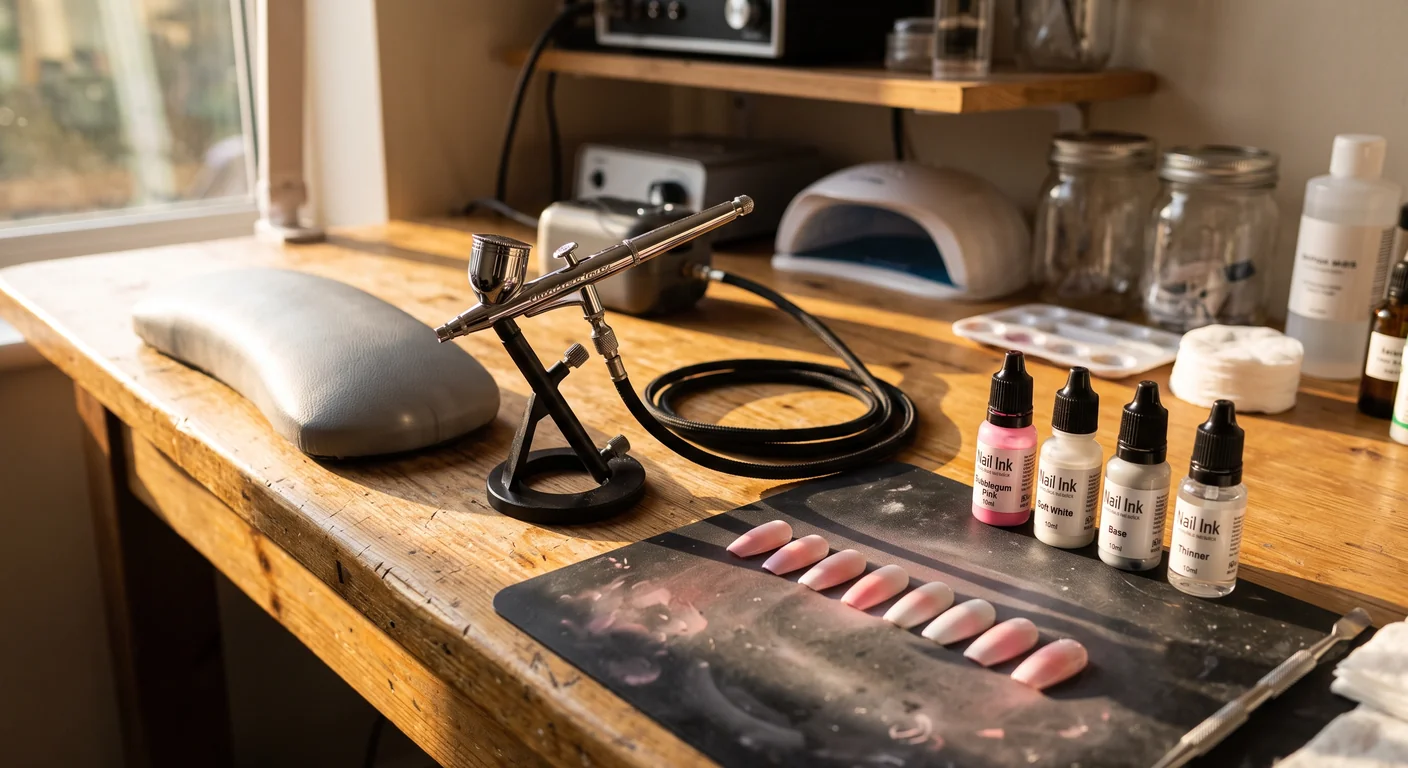
| Nails | 0.2mm | Tiny surfaces, extreme precision |
By Experience Level
Absolute beginner: Start with 0.35–0.5mm. Larger needles are more forgiving of imperfect paint thinning and less prone to clogging. You’ll learn faster with less frustration.
Intermediate: Move to 0.3mm as your primary, or get a 2-in-1 setup (0.2mm + 0.4mm) for maximum versatility.
Advanced: You already know what you need. Most advanced painters own multiple airbrushes or needle sets to cover the full range.
Needle + Nozzle = Always a Matched Set
This is critical to understand: the needle and nozzle must always be the same size. A 0.3mm needle must go with a 0.3mm nozzle. They’re precision-machined to work together, the needle tip seals perfectly into the nozzle bore to control paint flow.
You cannot put a 0.2mm needle into a 0.5mm nozzle (or vice versa). The seal won’t form properly, paint will leak or spray erratically, and you’ll damage both parts.
When buying replacement parts or new sizes, always buy the needle AND nozzle as a matched pair. Most manufacturers sell them together for exactly this reason. With some airbrushes (especially Harder & Steenbeck), you may also need the matching air cap/nozzle cap.
Do You Need Multiple Needle Sizes?
For many painters, a single 0.3–0.35mm needle covers 90% of their work. The temptation to collect every size is real, but resist it until you’ve actually hit a limitation with your current setup.
Consider a second size when:
- You need to prime/basecoat significantly faster (add a 0.5mm)
- You need finer detail than your current needle allows (add a 0.2mm)
- You switch between very different project types regularly
The 2-in-1 solution: Harder & Steenbeck’s Evolution and Infinity lines ship with two needle/nozzle sets (typically 0.2mm + 0.4mm). This covers both ends of the spectrum in a single airbrush, arguably the smartest approach for painters who need versatility without buying multiple airbrushes.
Needle Care and Replacement
Airbrush needles are the most fragile component in your airbrush. The tip is precision-ground to a fine point measured in hundredths of a millimeter. Bending this tip, even slightly, distorts the spray pattern.
Common causes of damage:
- Dropping the needle on a hard surface
- Pushing the needle through a clogged nozzle with force
- Inserting the needle from the wrong direction
- Cleaning with metal tools that contact the tip
Signs your needle needs attention:
- Spray pattern is off-center
- Splattering that doesn’t resolve with cleaning
- Paint flows when it shouldn’t (needle not sealing in nozzle)
- Visible bend when rolling on a flat surface
Minor bends can sometimes be straightened by rolling the tip on a fine ceramic sharpening stone (8000+ grit). Significant bends mean replacement, needles are relatively cheap (for Iwata, Harder & Steenbeck, or Badger) and trying to salvage a badly bent needle wastes time and produces inferior results.
Keep a spare. Having one spare needle for your airbrush means a bent tip is a 30-second fix instead of a session-ending problem.
Frequently Asked Questions
What is the best airbrush needle size for beginners?
A 0.35mm needle is the best starting point for most beginners. It’s forgiving of imperfect paint thinning, resists clogging better than smaller needles, and provides a good balance of detail and coverage. If you primarily paint miniatures, a 0.2mm with a flow limiter (like the Harder & Steenbeck Ultra 2024) is an excellent beginner option for that specific niche.
Can I change the needle size on my airbrush?
On many airbrushes, yes, but you need to change the nozzle too (they’re a matched set). Brands like Harder & Steenbeck design their Evolution and Infinity lines with interchangeable needle/nozzle sets. Some brands (especially budget models) have fixed needle sizes that can’t be changed. Check your manufacturer’s specifications.
What’s the difference between 0.3mm and 0.35mm?
Very little in practical terms. Both are mid-range all-purpose sizes. The 0.35mm sprays slightly more paint per trigger pull, gives marginally wider coverage, and is slightly more forgiving with thicker paints. Most painters would struggle to tell the difference in a blind test. Choose whichever your preferred airbrush model offers.
Do I need a 0.2mm needle for miniatures?
Not necessarily. Many excellent miniature painters use 0.3–0.35mm needles for most of their work. A 0.2mm needle gives you finer control for advanced techniques (OSL, detailed glazing, tight freehand), but it’s not required for basecoating, priming, zenithal work, or general color modulation. Start with 0.3–0.35mm and add 0.2mm when you feel limited.
- Best Airbrush for Beginners 2026. Airbrush recommendations by size
- Best Airbrush for Miniatures. Miniature-specific needle guidance
- Iwata vs Harder & Steenbeck. Brand comparison including 2-in-1 systems
- How to Thin Acrylic Paint. Thinning by needle size
- How to Clean an Airbrush. Needle cleaning and inspection
- Airbrush Troubleshooting Guide. Diagnosing needle-related problems